1902 – Birth of Hedley Albert Allan Dadd
On 22 January 1902, Hedley Albert Allan Dadd was born in Balmain South, NSW.
Hedley was the son of George Henry Dadd (1860-1921) and Elizabeth Fanny Fearnside (1859-1925). George was born in Portsmouth, Hampshire England and served in the Royal Navy. He came to Australia and served in the NSW Fire Brigade for over 30 years. He became inspector of country fire brigades. Elizabeth was born in Parramatta, NSW.
Youth
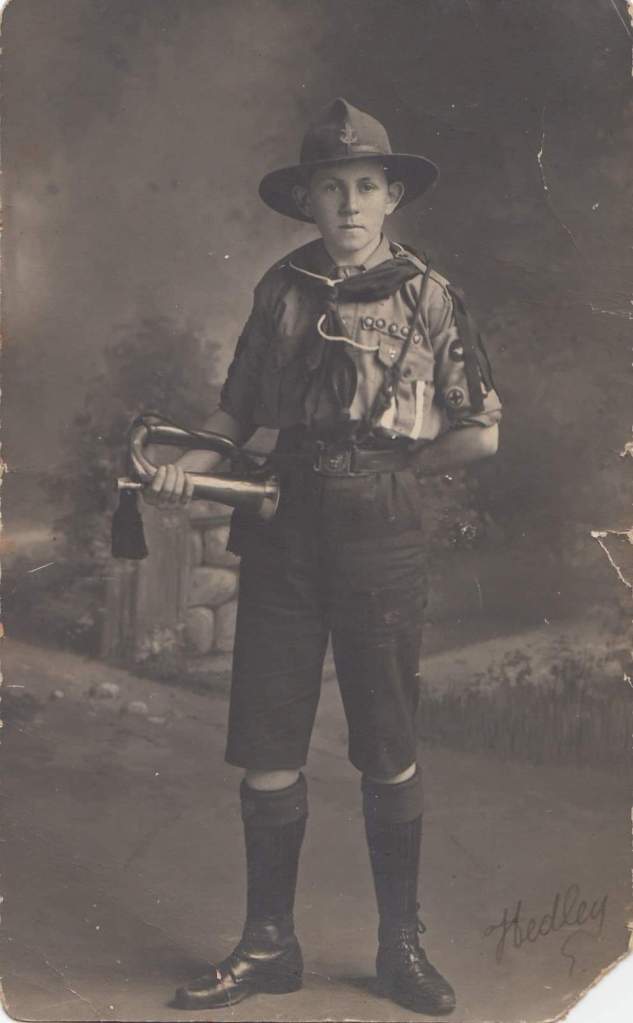
Hedley was a bugler and boy scout.
Dadd as a bugler in his youth. 1925 – Marriage to Agnes Isobel Rose
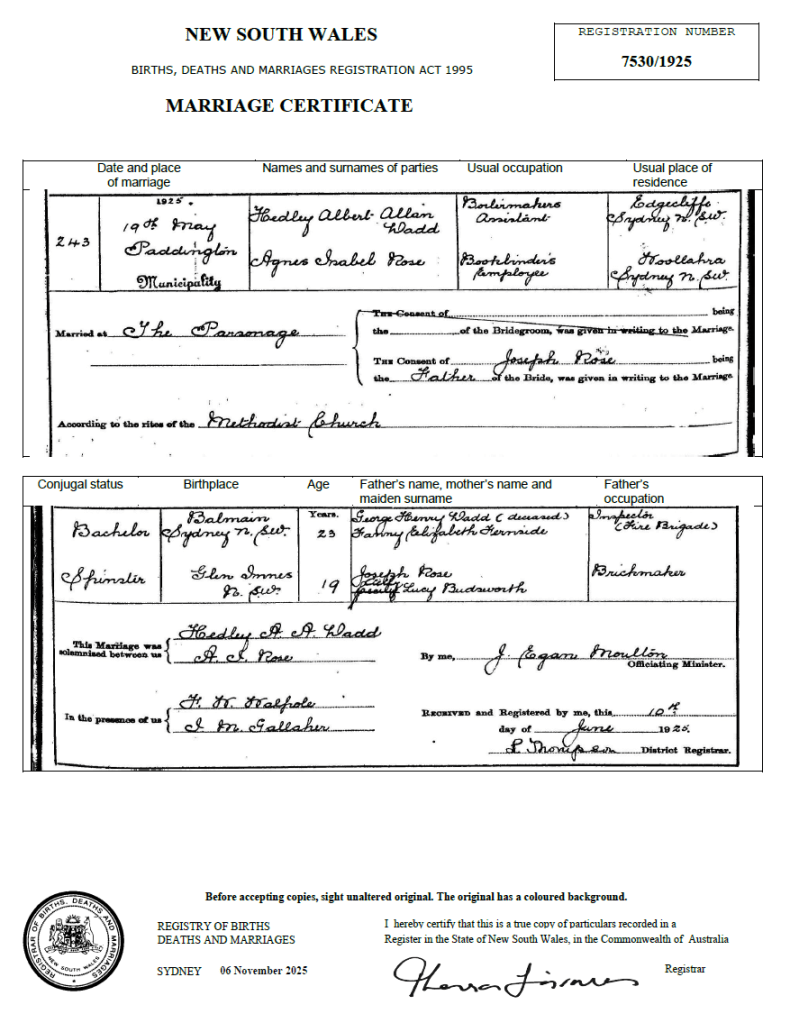
On 19 May 1925, Hedley married Agnes Isobel Rose in Paddington, NSW.
Details about Hedley and Agnes’ five children are located on Agnes’ page.
Adulthood
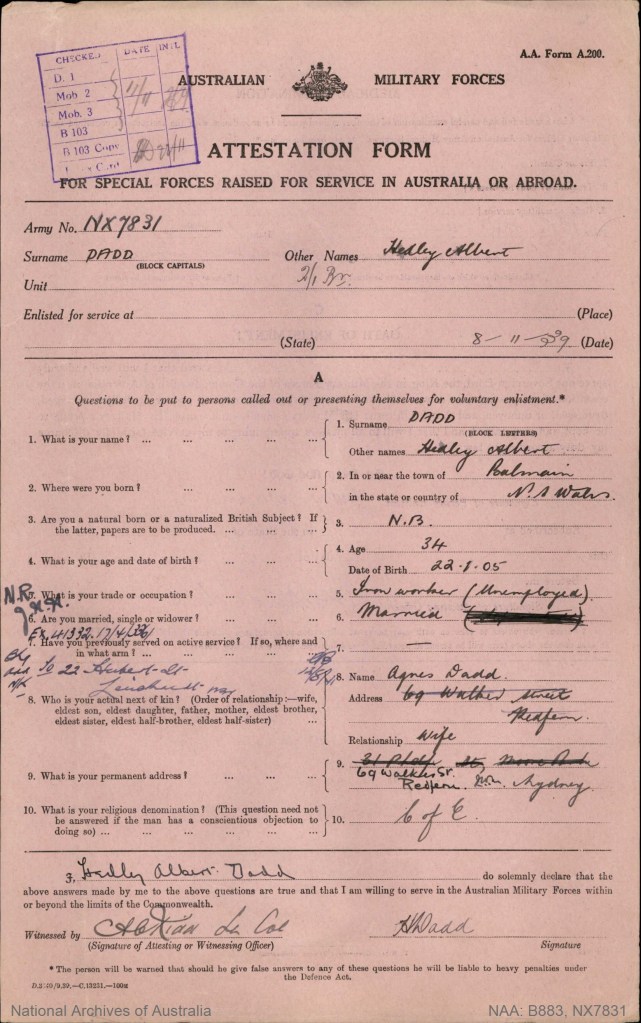
Hedley worked as an iron worker, but at the time World War 2 commenced, he was unemployed.
Dadd as a bugler in World War 2. 1939 – Enlistment in the Australian Military 2/1st Australian Infantry Battalion
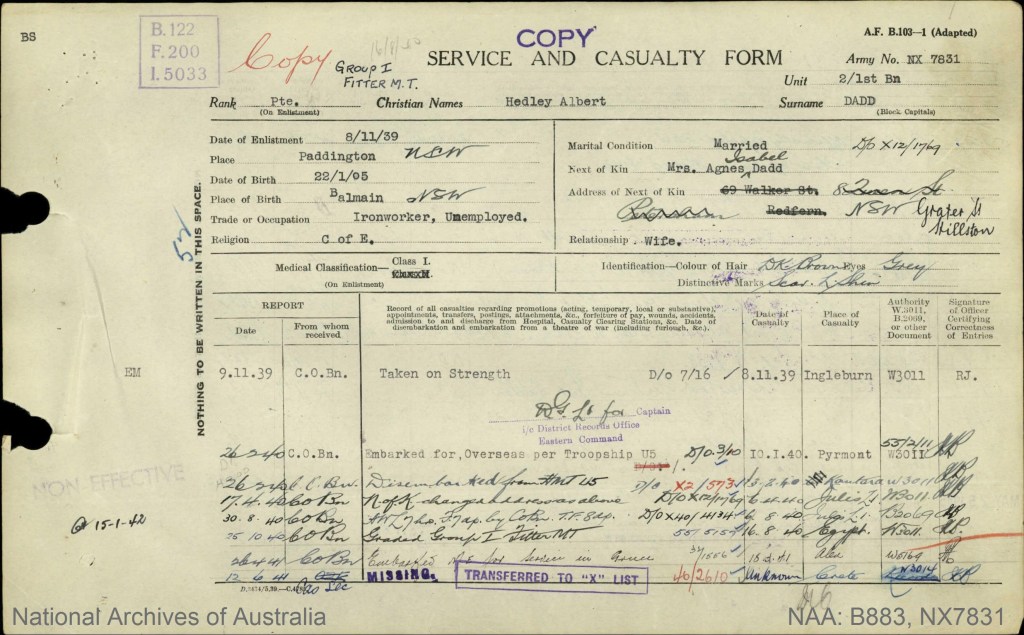
On 8 November 1939, Hedley enlisted in the Australian Military. Hedley was assigned to the 2/1st Australian Infantry Battalion.
1940 – Australian Military War Service
On 26 February 1940, Hedley embarked for overseas at Pyrmont onboard Troopship U5.
On 26 May 1940, Hedley disembarked in Kantara, Palestine.
In 25 October 1940, Hedley was stationed in Egypt.
“The brigade trained in Palestine until the end of August, when it moved to Egypt to carry out its final preparations for active service with the 6th Division.”
Postcards Hedley sent to the family from Egypt in December 1940.
1941 – The 2/1st Battalion – January 1941
“The 2/1st Battalion’s first campaign of the Second World War was the advance from Egypt into eastern Libya in January and February 1941. The battalion was involved in the attacks to capture Bardia (3-5 January) and Tobruk (21-22 January), and was left to garrison Tobruk as the advance continued. It left Tobruk on 7 March, ultimately bound for Greece with the rest of the 6th Division.”
“The 2/1st Battalion arrived in Greece on 22 March and was soon deployed north to resist the anticipated German invasion. The battalion occupied positions at Veria on 7 April but, in the face of superior German force, it began a long withdrawal south on 12 April and was evacuated by sea from Megara on 25 April. The battalion landed on Crete the next day and was subsequently deployed with the 2/11th Battalion to defend the critical airfield at Retimo.”
In May 1941, Hedley was involved in the battles for the island of Crete.
The German airborne invasion of Crete began on 20 May but a tenacious defence denied them Retimo airfield until 30 May. German victories elsewhere on Crete, however, allowed them to concentrate overwhelming force against Retimo and, short of rations and ammunition, the 2/1st surrendered and became prisoners of war.”
The Australian War Memorial describes these battles in more detail as follows:
“The battles for the island of Crete were fought from the second week of May 1941 when the island’s British, Commonwealth, and Greek garrison was attacked by German airbourne troops. The defender’s numerical superiority was eventually overwhelmed by the attacker’s massive advantage in logistic and air support. By the end May, organised resistance had broken down… four Australian battalions and a field regiment (artillery) held the area from Georgiopolis to Retimo (Rethymnon), supported by three battalion-strength Greek regiments and local police… The German parachute assault groups… began landing at the airfield at Maleme at dawn. By mid-afternoon both the airfield at Heraklion and the airstrip at Retimo were under attack. In the countryside and villages of the Heraklion and Retimo sectors, the Germans were driven from their objectives. The Allies denied the airfields to the enemy but were cut off from each other as they fought bitter battles on their flanks… by 26 May… at Retimo… the New South Welshmen of the 2/1st Battalions, still fighting to deny the airstrip to the Germans, were cut off… By 30 May Lieutenant Colonel Ian Campbell, commanding officer of the 2/1st Battalion and Retimo Force commander, decided further resistance at Retimo was pointless and ordered his men to surrender.”
On 30 May 1941, the Australian 2/1st Infantry Battalion surrendered and Hedley and the remaining troops were captured by the Germans.
From 1 June to July 1941, Hedley was interned on Crete.
On 12 June 1941, Hedley was listed as Missing In Action on Crete.
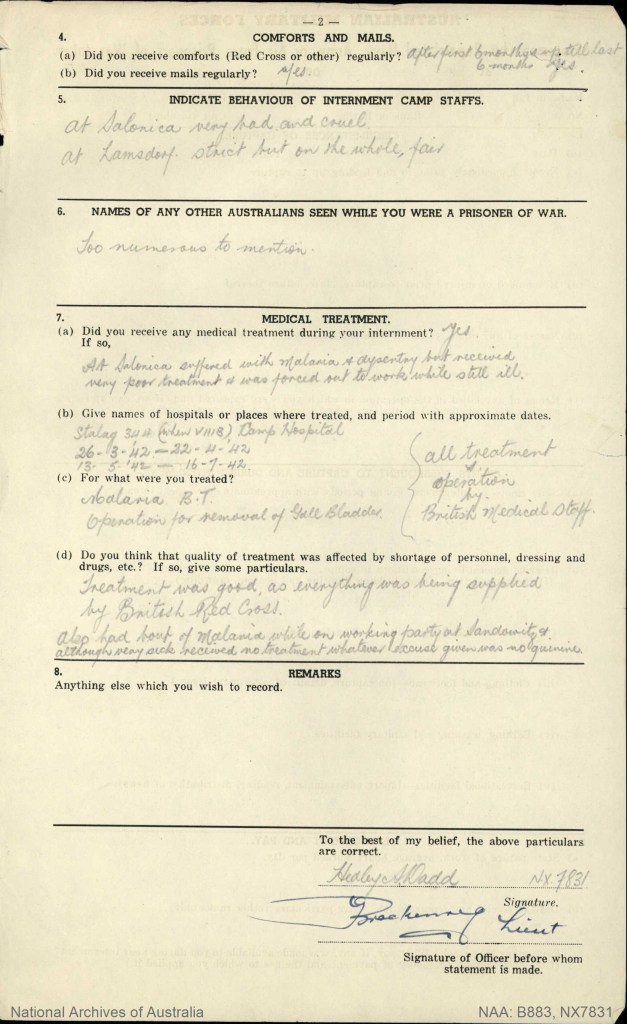
From July to 1 October 1941, Hedley was interned in Salonica, Greece. Hedley wrote “Salonica everything bad. No bedding, lighting or heating.” Behaviour of internment camp staff “At Salonica very bad and cruel”. “At Salonica suffered with malaria & dysentery but received very poor treatment & was forced out to work while still ill.”
On 1 October 1941, Hedley was transported to Germany.
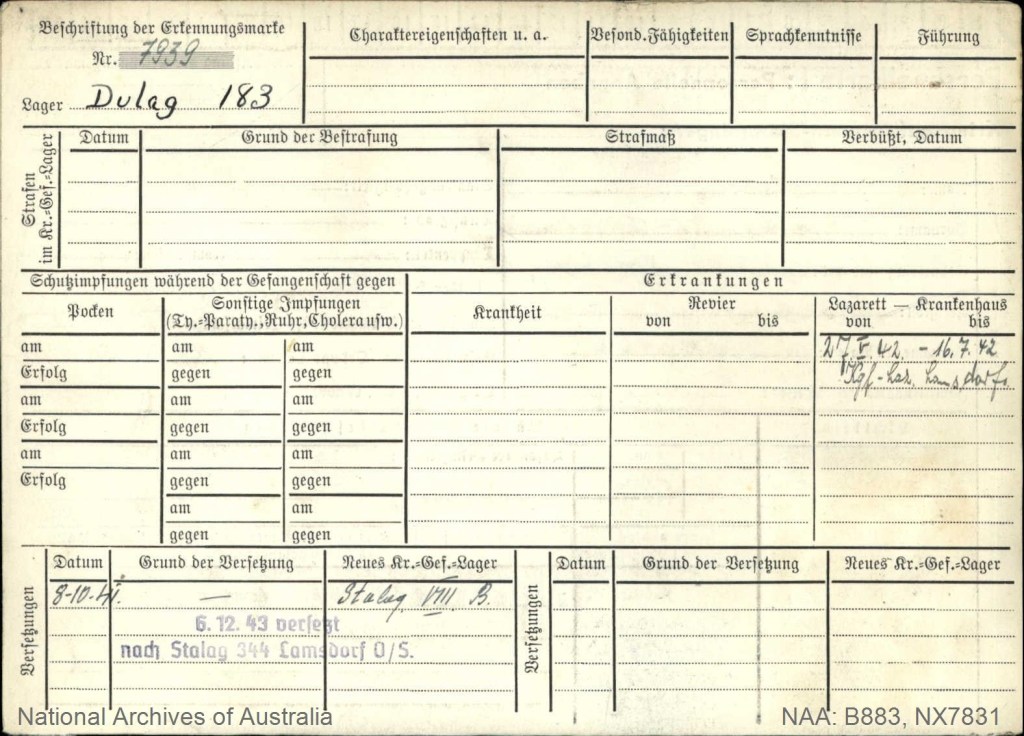
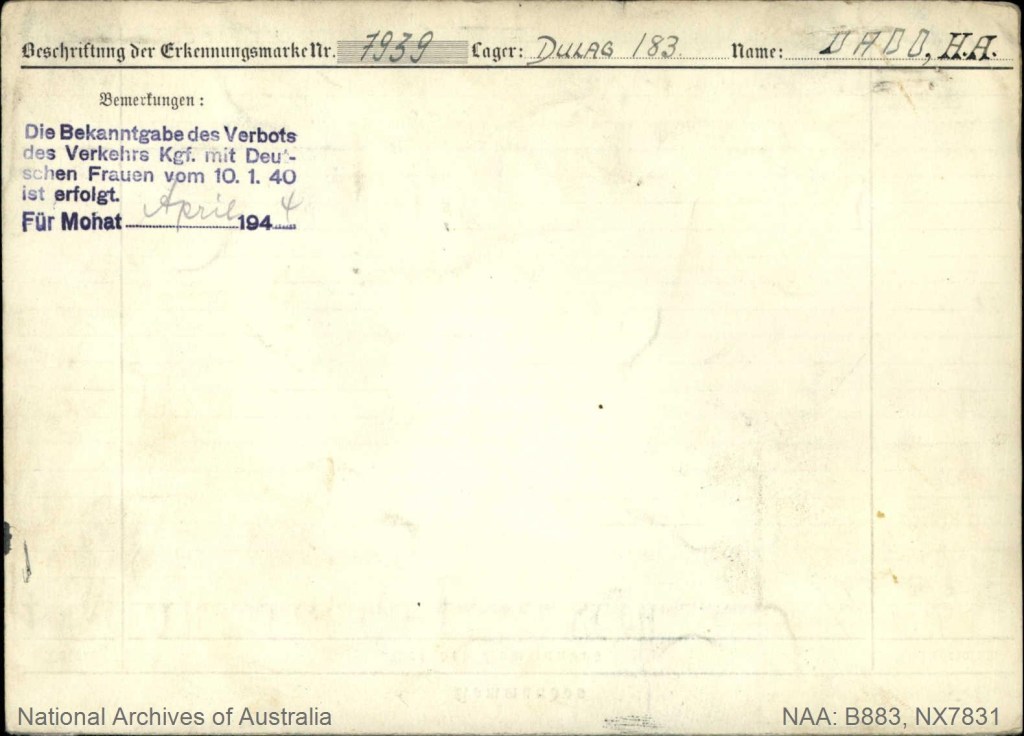
On 9 October 1941, Hedley arrived in Stalag VIII-B (later renamed Stalag-344) .
On 5 January 1942, Hedley was official reported as a Prisoner Of War.
Stalag VIII-B (Stalag-344)
“during the Second World War, one of the largest POW camp complexes in Europe – the Lamsdorf Stalags – operated near the village. Its construction began as a POW transit camp called Dulag B (Durchgangslager ), organized before the outbreak of the war in August 1939. In October 1939, this facility was transformed into a permanent camp for private soldiers and non-commissioned officers – Stalag VIII B Lamsdorf (Mannschaftsstammlager ).”
“in 1940, it was one of the most distant POW camps from the front and Great Britain. It also had a convenient location: away from larger cities, accessible by railway and near an industrial district that needed cheap labour.”
“Stalag VIII B was expanded into an extensive complex with sectors for soldiers of individual armies, additionally divided by service and rank. The Britenlager consisted of two clearly separate parts: the administrative and storage pre-camp and the main camp itself with sectors between which it was possible to move only during the day. The camp was built-up with brick or wooden barracks consisting of two rooms, each designed for about 130 men, with two- or three-story bunks, some tables and benches. One sector included four barracks and common latrines. Other elements of the camp infrastructure included the kitchen, the dining room, the barrack used as a chapel, school or theatre and pitches which served as roll-call squares and fields for holding numerous sports activities. The camp was surrounded by a barbed wire fence, typical of this type of place, with external posts and guard towers (Sawczuk and Senft Citation2006).”
“The living conditions were bad and became worse with every year. This was due to the increasing overcrowding of the camp, insufficient heating of the barracks in winter and their increasingly poor technical condition (including missing window panes). In addition, moisture, insects and plagues of aggressive rats were among the everyday problems faced by the POWs. Meals, their preparation, and especially efforts to ensure the most equitable distribution of food were an important aspect of the camp life.”
Hedley wrote “Stalag 344, bedding poor, lighting poor. Heating bad & in cases overcrowded. Rations quantity fair, quality very poor. No clothing issued outside British Red Cross supplies. Only wooden clogs. Bath 1 per week, 1 small cake of soap issued once per month. Water for washing very scarce. All recreational facilities only what were made by British Red Cross & YMCA.” Employment “For 3.5 years at sugar factory 12 hours per day. Sundays during off season free.” Renumeration “Offseason 10 pfennings per day, in season 1 mk 20 phennings”. Behaviour of internment camp staff “At Lamsdorf strict but on the whole, fair”.
Hedley wrote about requiring medical treatment: “Camp Hospital 26.3.42-22.4.42, 13.5.42-16.7.42.” Treated for “Malaria B.T. & Operational for removal of gall bladder. All treatment & operation by British medical staff”. “Treatment was good, as everything was being supplied by British Red Cross. Also had bout of malaria while on working party at Sandurvitz & although very sick received no treatment whatever excuse given was no quinine.”
Prisoner of War Documentation
On 22 January 1945, the Germans evacuated the Stalag VIII-B camp as the Soviet armies were approaching. The Prisoners Of War were sent on forced marches westward, with many dying en route.
“At the end of 1944, in view of the approaching eastern front, the German authorities prepared plans to evacuate the camp to the west and deep into the territory of the Third Reich. At the beginning of January 1945 they repatriated 700 sick British POWs, and on 22 January 1945, they started a general evacuation which continued in the following days. It covered almost 22,000 British POWs from the camp and working units. Leaving Lamsdorf in columns of about 1,000 people each, they set out on an exhausting march which lasted even several weeks, under strict guard, with small food rations and in severe frost. Hence, in the POWs’ accounts, the term ‘death march’ is often used.”
1945 – Hedley Survives WW2
On 25 May 1945, London reported that Hedley had been recovered as a Prisoner Of War.
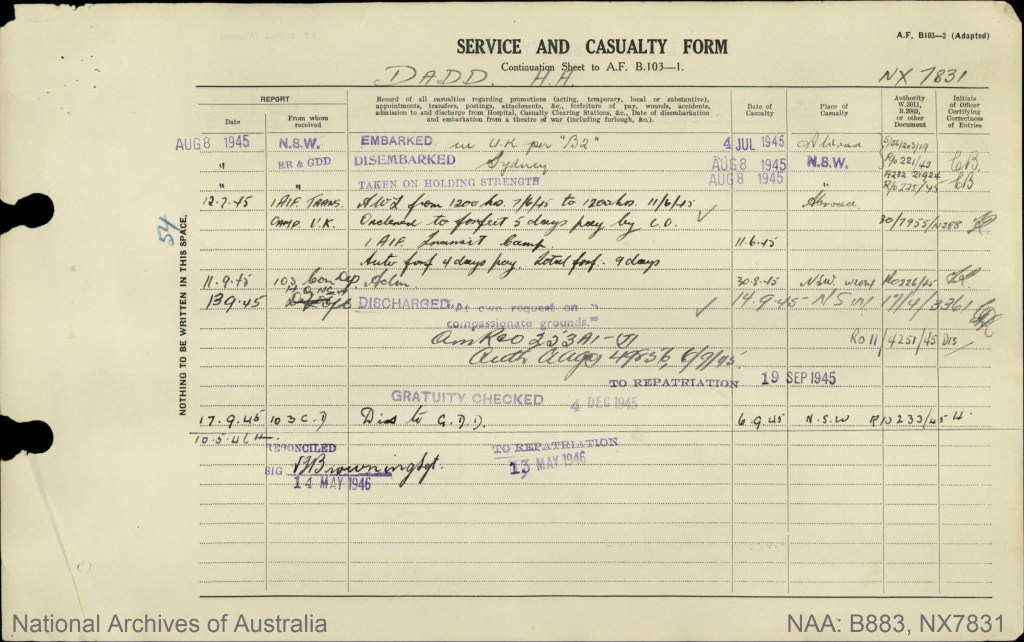
On 4 July 1945, Hedley departed London.
On 8 August 1945, Hedley arrived in Sydney.
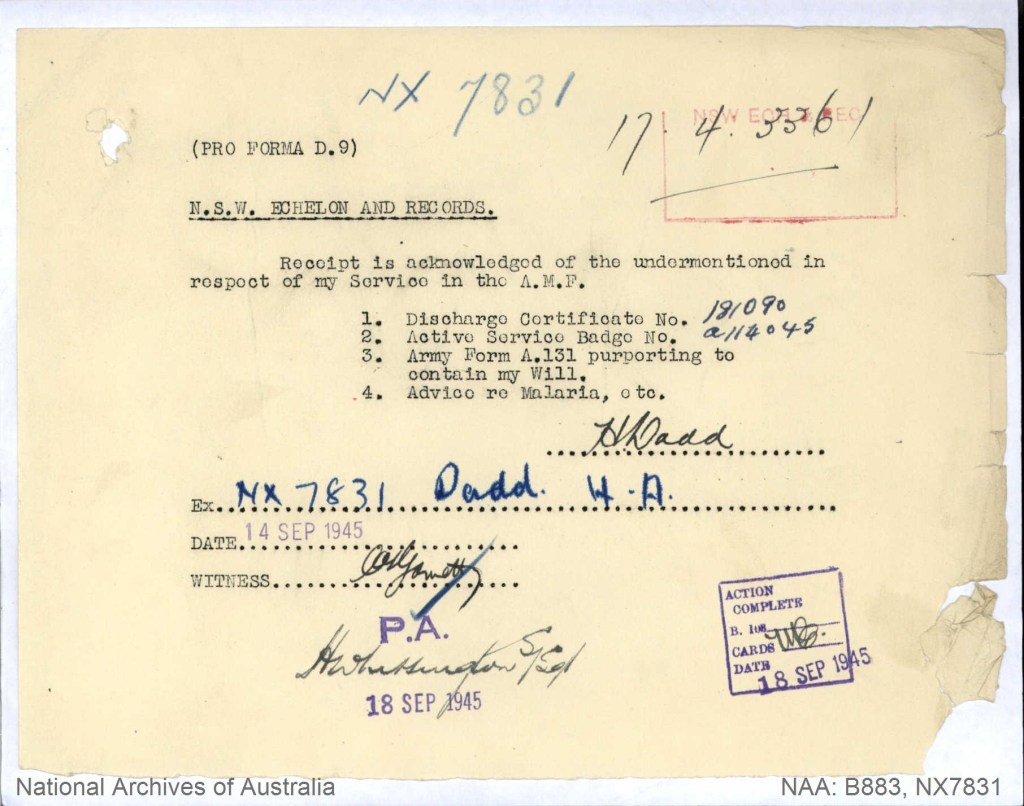
On 13 September 1945, Hedley was discharged from the military at his own request on compassionate grounds.
1945 – Australian Military Forces – Statement by Repatriated Prisoner of War
1945 – Discharge Paperwork
The Australian War Memorial Records
Casualty Section / 2nd Echelon / Army No. NX7831
Next of Kin: Mrs Agnes I Dadd
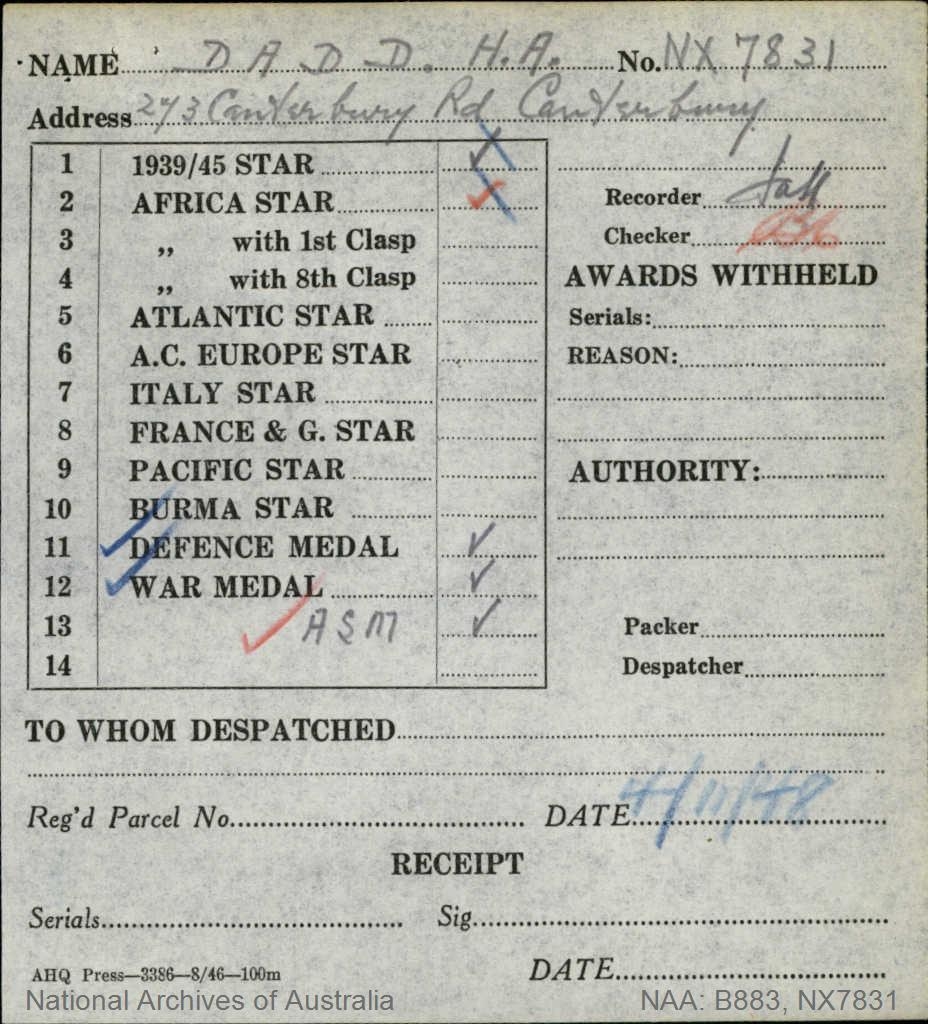
1948 – Military Awards
On 4 November 1948, Hedley was awarded the 1939/45 Star, the Africa Star, the Defence Medal, War Medal, and the Australian Service Medal.
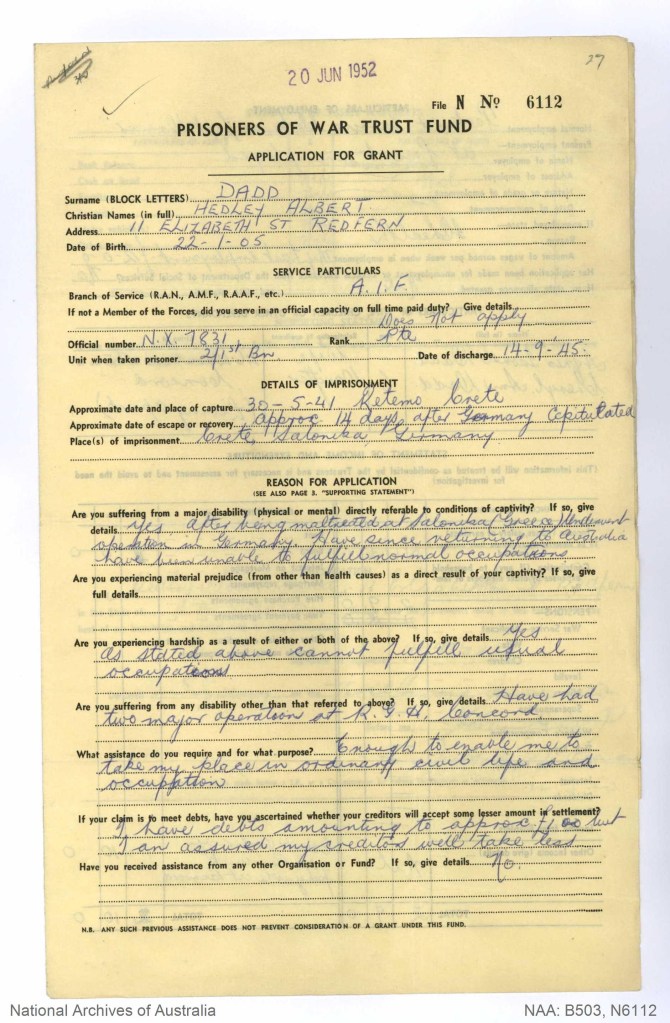
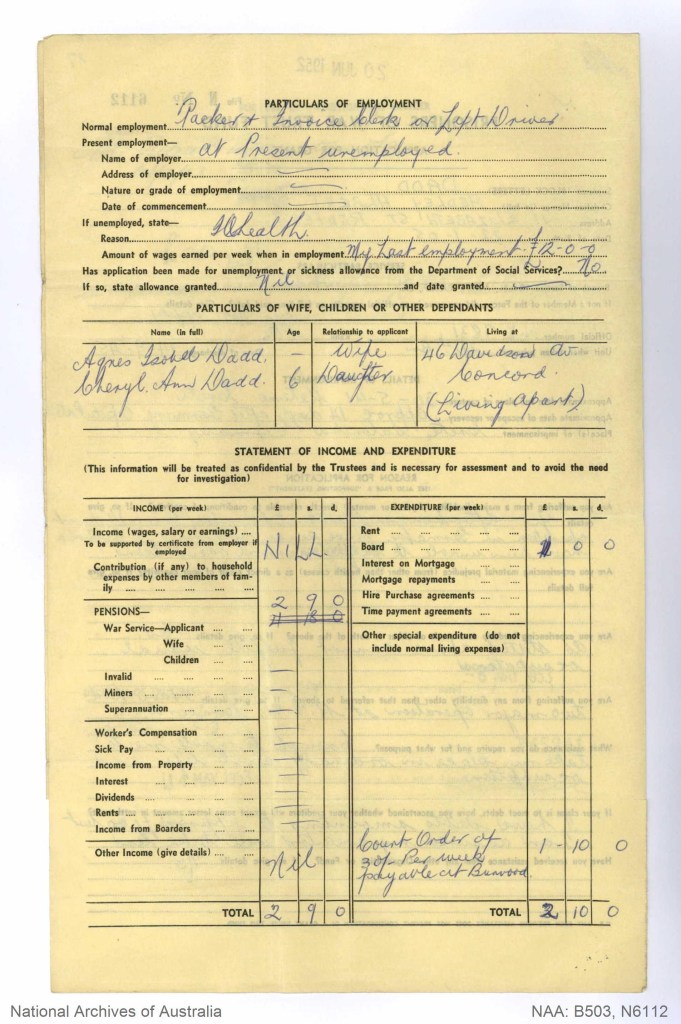
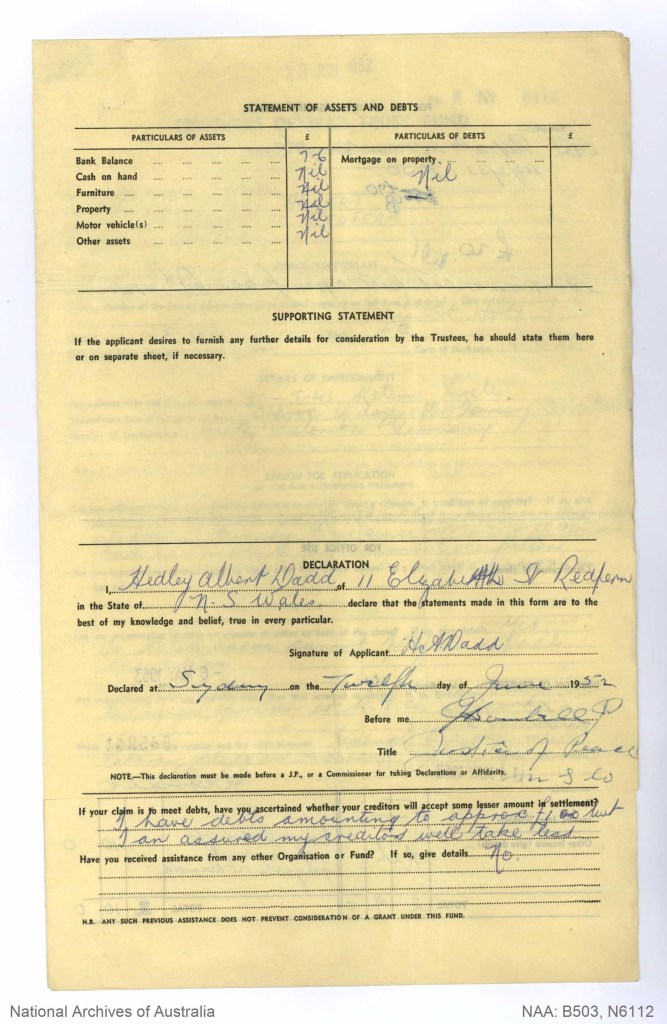
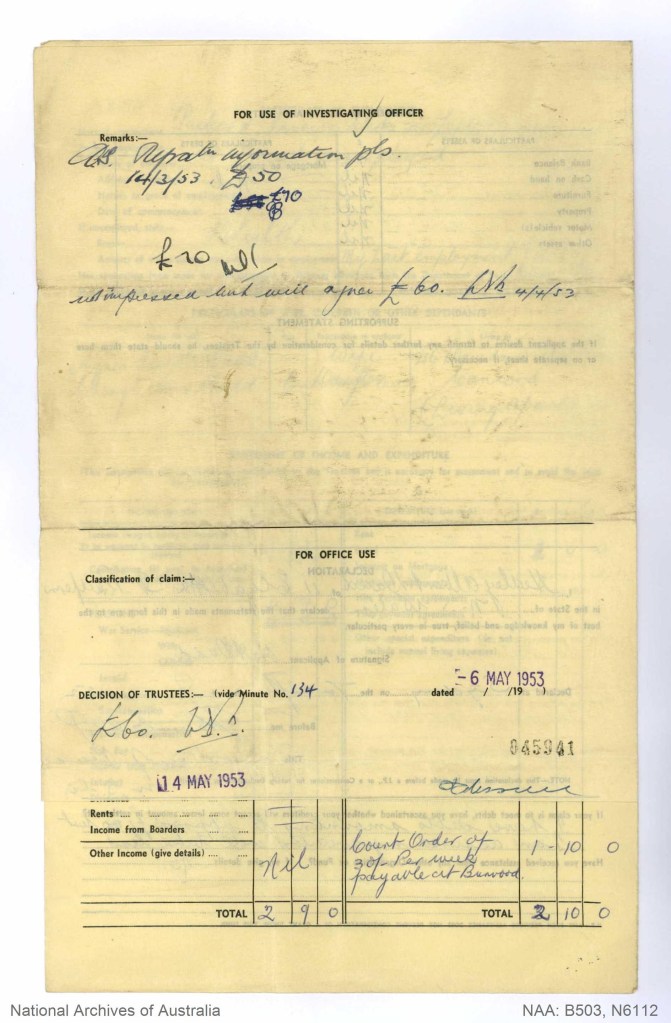
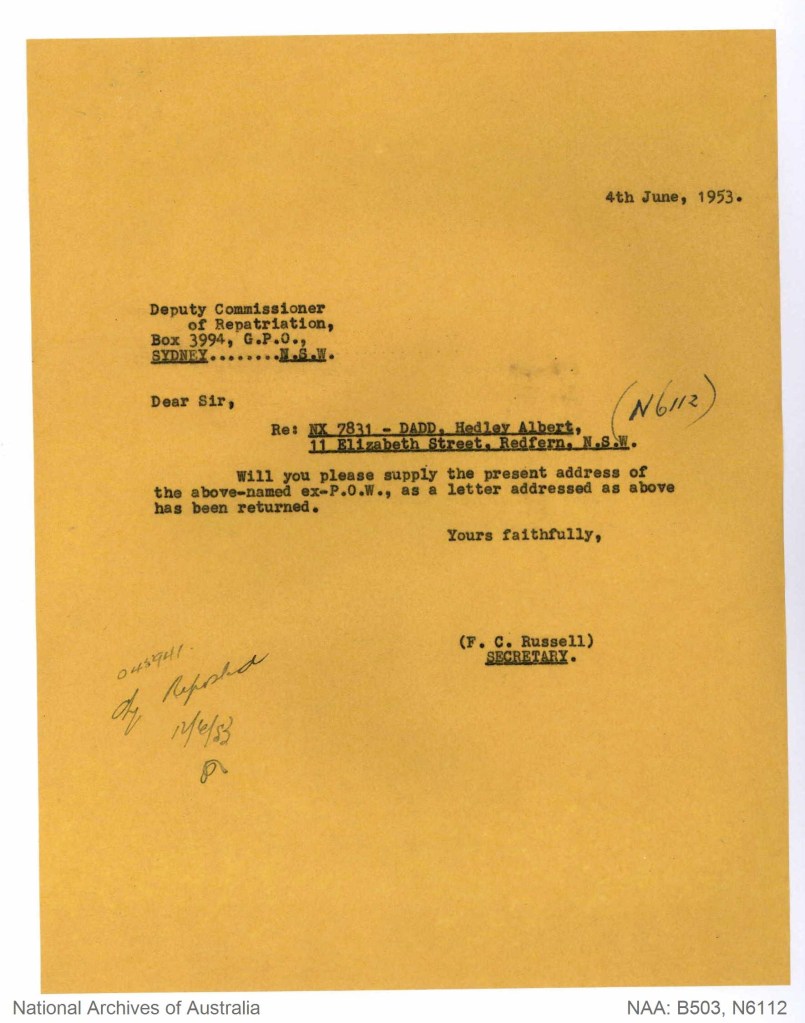
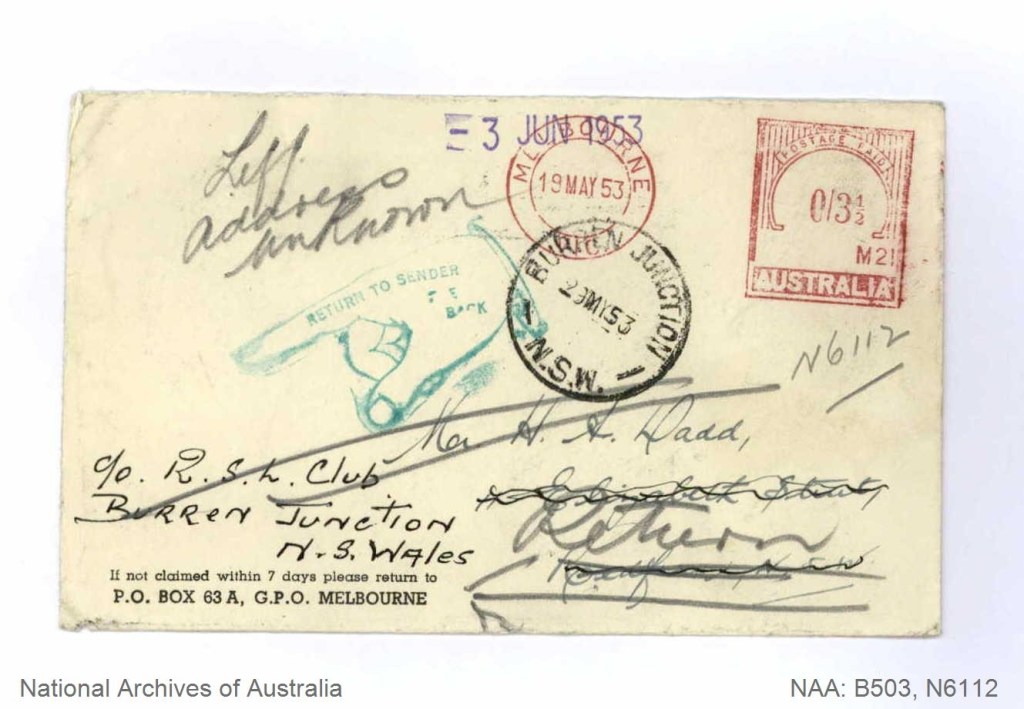
1952 Prisoners of War Trust Fund Application
In 1952, Hedley submitted a Prisoners of War Trust Fund Application.
1965 – Death of Hedley Albert Dadd
On 16 February 1965, Hedley Albert Dadd died at Concord Repatriation General Hospital.
On 18 February 1965, Hedley was buried at the Methodist Cemetery, Rookwood, NSW.
Registration Number: 830/1965
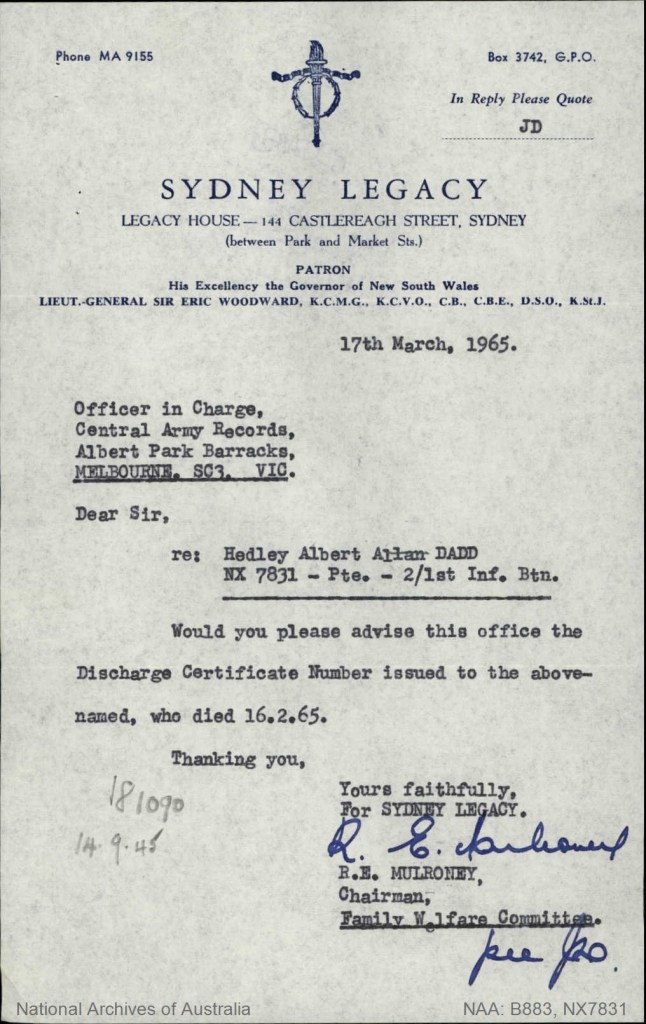
In March 1965, Sydney Legacy wrote the following letters.













 Kitty of the Warmuli Clan of the Dharug people & Joseph Budworth