1860 Birth
George was born on 11 May 1860 in Portsea, Hampshire, England.
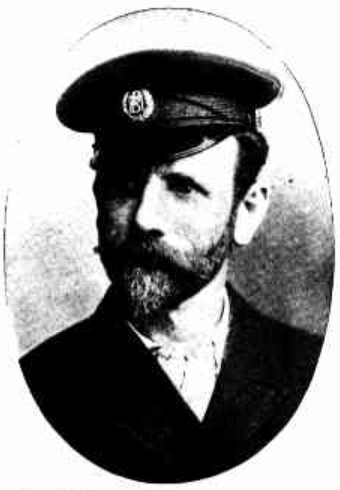
He was the son of James Dadd and Caroline according to the 1871 England and Wales Census.
1871 Census
In the 1871 England Census, George was recorded as follows:
- Name: George Dadd
- Sex: Male
- Age: 11
- Birth Year (Estimated): 1860
- Birthplace: Portsea, Hampshire
- Occupation: Scholar
- Relationship to Head of Household: Son
- Event Type: Census
- Event Date: 1871
- Event Place: Portsea, Hampshire, England, United Kingdom
- Event Place (Original): Portsea, Portsea, Hampshire, England
- Sub-District: Portsea Town
- Enumeration District: 2
- Household Identifier: 127
- Entry Number: 16
1875 – Joined the Royal Navy Service
On 20 October 1875, Dadd joined the United Kingdom Royal Navy. He was listed as being 5 feet 4 inches tall, with light brown hair, hazel eyes, and a “fresh” complexion. He was a shoemaker by trade. The National Archives of the UK; Kew, Surrey, England; Royal Navy Registers of Seamen’s Services; Class: ADM 188; Piece: 102.
1875-1876 H.M.S. St Vincent in England
From 20 October 1875 to 1 April 1876, Dadd served on the ship H.M.S. St Vincent in the Royal Navy. Dadd’s character was stated as “Good”. The National Archives of the UK; Kew, Surrey, England; Royal Navy Registers of Seamen’s Services; Class: ADM 188; Piece: 102.

1876-1880 H.M.S. Danae from England to Australia
From 8 November 1876 to 17 August 1880, Dadd served on the ship H.M.S. Danae. Dadd’s character was stated as “Good”.
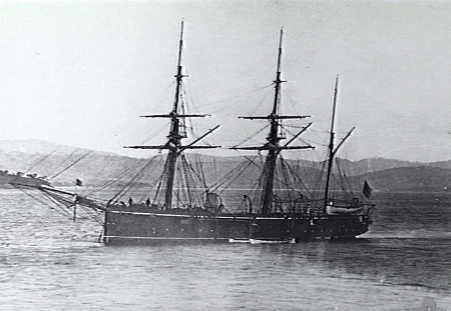

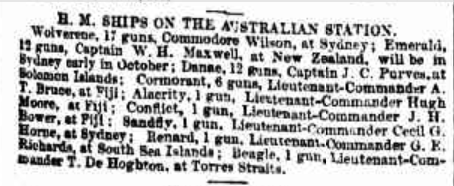
In October 1879, Dadd disembarked in Sydney.
In August 1880, the Danae sailed from Australia back to England, though Dadd had joined the H.M.S. Emerald by this time.
1880-1882 H.M.S. Emerald in Australia
From 28 August 1880 to 20 June 1881, Dadd served on the ship ‘Emerald’. The National Archives of the UK; Kew, Surrey, England; Royal Navy Registers of Seamen’s Services; Class: ADM 188; Piece: 102.
The Emerald was an Emerald-class corvette launched in 1876. From 1878 to 1882 it was captained by Captain William H. Maxwell.
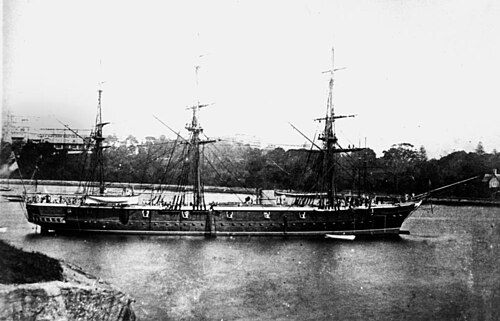
In October 1881, the Emerald left Australia and sailed to England. Dadd was noted as a “Bugler”. Dadd’s character was stated as “Good”.
1882-1883 H.M.S. Nelson in Australia
From 16 April 1882 to 18 May 1883, Dadd served on the ship Nelson. The National Archives of the UK; Kew, Surrey, England; Royal Navy Registers of Seamen’s Services; Class: ADM 188; Piece: 102.
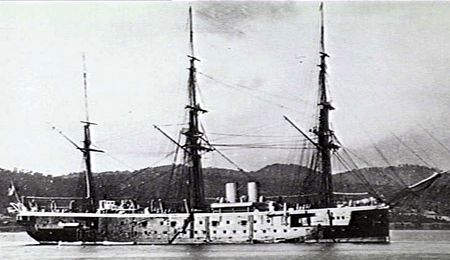
Dadd finished his service onboard the Nelson on 18 May 1883. Dadd’s character was stated as “Good”.
~1885 – Joined the New South Wales Fire Brigade
After leaving the navy, Dadd joined the New South Wales Fire Brigade.
1885 – Marriage to Elizabeth Fanny Fearnside
On 3 March 1885, Dadd married Elizabeth Fanny Fearnside in Young, NSW. NSW BDM, Marriage Registration 7552/1885.
On 1859 Elizabeth Fearnside was born in Parramatta, New South Wales. NSW BDM Birth Certificate Registration 10752/1859. She was the daughter of Edwin Horner Fearnside and Eliza Jane Perkins, who were both born in England and had travelled to Australia in 1852.
1890 – Fire Brigade District Officer
On 13 February 1890, Dadd was stated by the Parliament of New South Wales to be the Metropolitan Fire Brigade District Officer of the Western District, No. 43 Station.
1899 – Fire Brigade Instructor
On 2 May 1899, the newspaper Mudgee Guardian and North-Western Representative stated Dadd was a fire brigade instructor:
“Mudgee Fire Brigade. Drills are boing hold every evening under Instructor George Dadd, and the men are making good progress. We hear that the Resident Engineer of the water works was applied to for permission to use some of the water in the mains, but permission was not granted on the ground that there is so little water. We certainly think it a great pity that now the instructor is here there should not be a complete drill. Perhaps the matter could be arranged somehow.”
1905 – Senior Officer in the New South Wales Fire Brigade


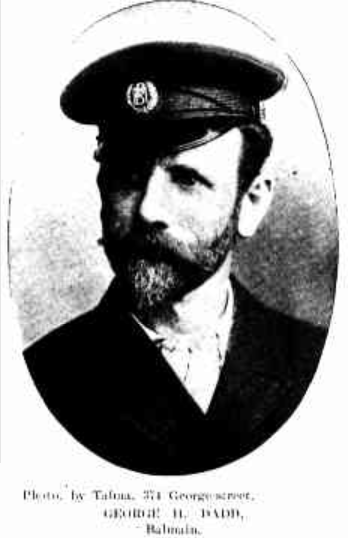
Dadd rose to become the inspector of country fire brigades.
1921 – Death of George Henry Dadd
On 29 September 1921 Dadd died in Granville, New South Wales. NSW BDM Death Registration Number 12524/1921.

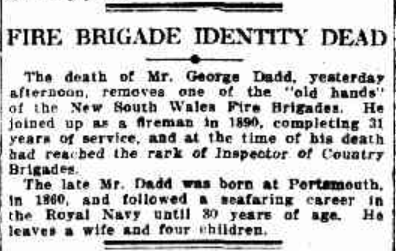
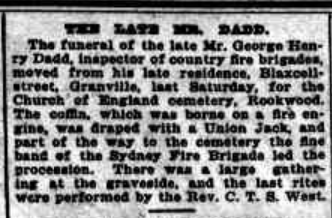
On 1 October 1921 Dadd was buried at Rookwood General Cemetery.
On 8 October 1921 the newspaper The Cumberland Argus and Fruitgrowers Advocate stated:

 Kitty of the Warmuli Clan of the Dharug people & Joseph Budworth