c.1809 – Birth of Kitty of the Cannemegal (Warmuli) or Prospect clan of the Dharug people in Australia
Kitty of the Cannemegal (Warmuli) or Prospect clan of the Dharug people was born in c.1809.

The Dharug People
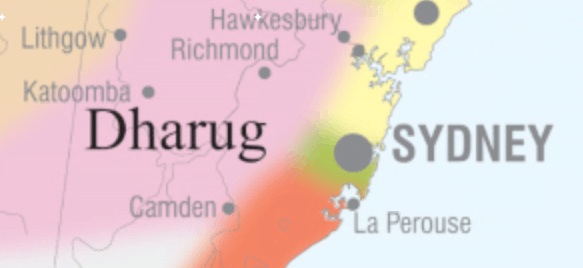
“Warali Wali (‘possum’ in Darug language) is a traditional totem of the Darug people“. The Aboriginal artwork below has been purchased and included in the website banner to represent Kitty and our large family’s proud Dharug heritage.

Valuable information about the Dharug language is found at bayala.net.au.
1813 – Birth of Joseph Budworth in England
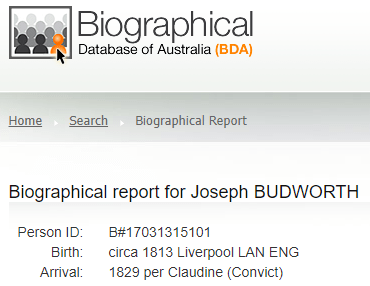
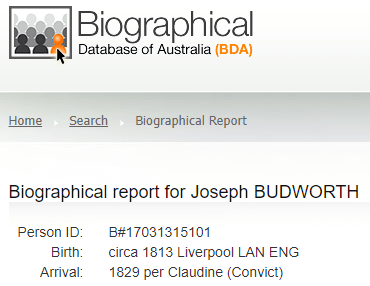
Joseph Budworth, Kitty’s future partner and father of six of her children, was born in 1813 in Liverpool, Lancashire, England. His parents are unknown, as is discussed at the bottom of this page under the heading ‘Joseph Budworth’s Unknown Parents and Mistaken Identity’.
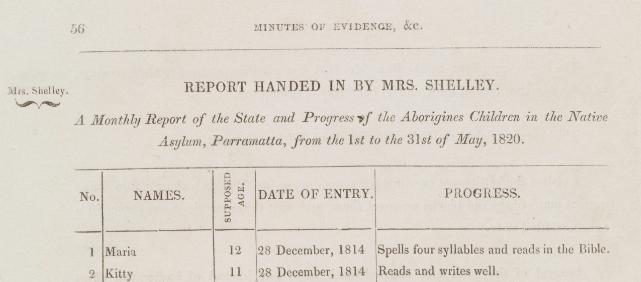
1814 – Kitty Admitted to the Parramatta Native Institution
On 28 December 1814, Kitty was in the first cohort of Aboriginal students admitted to the Parramatta Native Institution, along with three other girls named Maria (whose brother Colebee would later marry Kitty), Fanny and Friday.

1814 – Establishment of the Parramatta Native Institution

On 4 January 1817, the Sydney Gazette published a newspaper article which included the following:


Governor Macquarie directed “That no Child after having being admitted into the Institution, shall be permitted to leave it, or be taken away by any Person whatever, (whatever Parents or other relatives) until the Boys shall have attained the age of sixteen years, and the Girls fourteen years.”1
“Aboriginal parents had resisted the school and pined for their children from the beginning – an open slat fence was built early in 1815 to provide parents the requested opportunity to gaze upon their children while at school. Shelley, before his early death in 1815, noted the reluctance of Aboriginal parents to give up their children and Yarramundi spoke of the fear of ‘men in black clothes’ taking the children to the Institution in 1818.” (Brook and Kohen, 1991, p.263).
Kitty’s First Husband – Colebee
William Cox
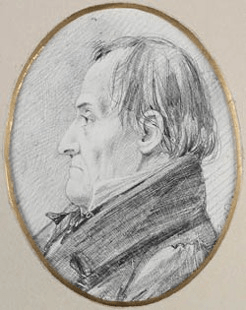
On 12 July 1814, Governor Macquarie commissioned Cox to build a road across the blue mountains.
William Cox & Colebee
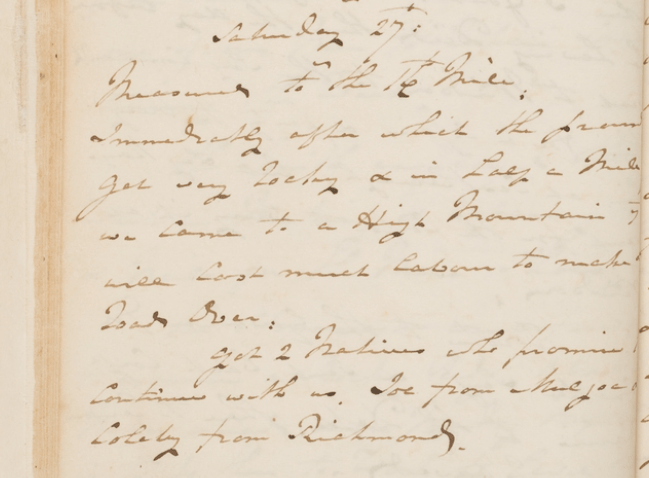
In 1816, Colebee was an Aboriginal guide for Military Detachments sent out by Governor Macquarie.2
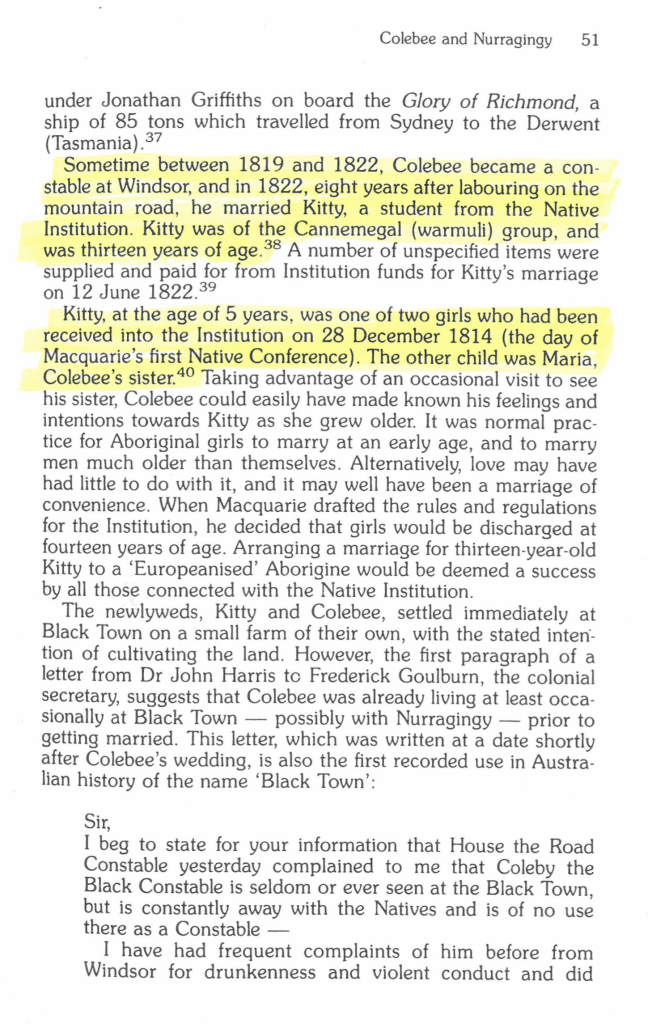
Between 1819 and 1822, Colebee became a constable at Windsor (Brook and Kohen, 1991, p.51).
1822 – Kitty Marries Colebee
On 12 June 1822, Colebee married Kitty. “A number of unspecified items were supplied and paid for from Institution funds” (Brook and Kohen, 1991, p.51).
Brook and Kohen (1991, p.51) state that “taking advantage of an occasional visit to see his sister, Colebee could easily have made known his feelings and intentions towards Kitty as she grew older. It was normal practice for Aboriginal girls to marry at an early age, and to marry men much older than themselves. Alternatively, love may have had little to do with it, and it may well have been a marriage of convenience. When Macquarie drafted the rules and regulations for the Institution, he decided that girls would be discharged at fourteen years of age. Arranging a marriage for thirteen-year-old Kitty to a ‘Europeanised’ Aborigine would be deemed a success by all those connected with the Native Institution..
Brook and Cohen (1991, p.51) identify that “the newlywed, Kitty and Colebee, settled immediately at Black Town on a small farm of their own, with the stated intention of cultivating the land.” A letter which Dr John Harris wrote to Frederick Goulburn, the colonial secretary, is “the first recorded use in Australian history of the name ‘Black Town’. This letter stated: “Sir, I beg to state for your information that House the Road Constable yesterday complained to me that Coleby the Black Constable is seldom or ever seen at the Black Town, but is constantly away with the Natives and is of no use there as a Constable – I have had frequent complaints of him before from Windsor for drunkenness and violent conduct…” (p.51).

1823 – Birth of Kitty’s Son Samuel
In 1823, Kitty and Colebee had a son, named Samuel.3 (See 23 August 1827 baptism certificate 867: Vol 128. below).
1824 – Background of Joseph Budworth (born c.1813)
In 1824, while Kitty was married and had her first son in Sydney, Australia, on the other side of the world in Liverpool, England, there was an 11 year old boy named Joseph Budworth who was in trouble with the law. Incredibly, this boy would later become Kitty’s second husband.
Budworth was born c.1813 in Liverpool, Lancashire, England.

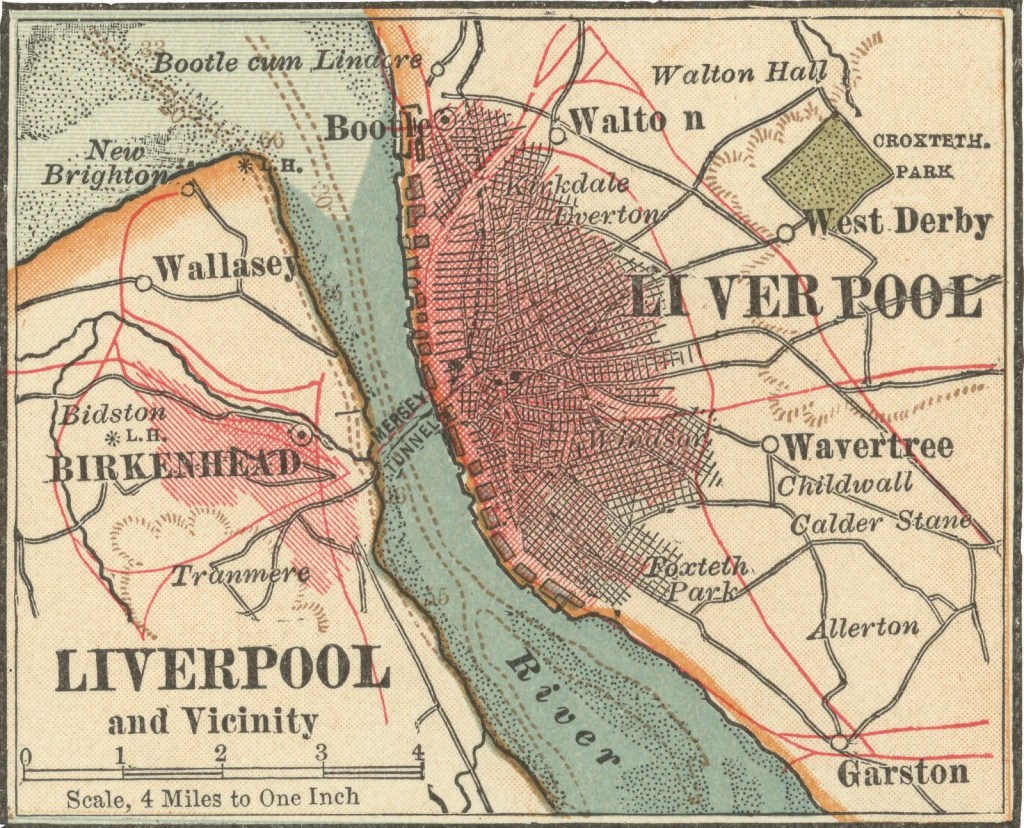
On 24 September 1824, Budworth was committed with having feloniously stolen three shillings and ninepence, in silver and copper monies.4


In October 1824, Budworth was listed on the County of Lancashire, Liverpool, England, as being tried for the crime of felony. He was sentenced to “6 months and whipped time.”5


In October 1826, Budworth was listed as a prisoner at Liverpool Gaol who had been previously committed and convicted of felony 3 times. This states his name was “Joseph Budworth alias Davis”. He was convicted in October 1826 and discharged in April 1828.6

1827 – The Baptism of Samuel
On 23 August 1827, Kitty and Colebee’s son Samuel was baptised at St Mary’s Roman Catholic Church in Richmond.3

1829 – Joseph Budworth Sentenced to 7 Years in Australia
On 29 March 1829 in Lancashire, England, Budworth was committed as a criminal, charged with feloniously stealing one firkin of butter, and sent to the Liverpool Jail.8


On 30 March 1829, The Albion reported the following:


On 4 May 1829 at the Liverpool Court, Budworth was tried for feloniously stealing butter, and at trial sentenced to 7 years transportation to Australia. He had four previous convictions at this time.9




The 8 May 1829 ‘The Liverpool Mercury’ newspaper reported the following on page 159:


1829 – Joseph Budworth Transported to Australia
On 26 June 1829, Budworth was sent to the prison hulk Justita to await his transportation to Australia.


On 10 August 1829, Budworth and the other 59 convicts onboard were transferred from the Justita onto the Claudine at Woolwich, England.
On 15 August 1829, the Claudine arrived in Plymouth. That evening, another 120 convicts were transported onto the ship.

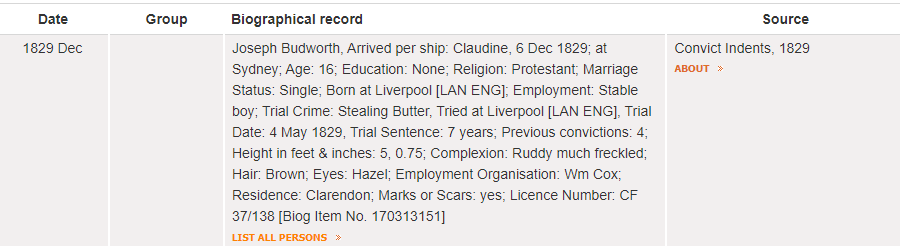
The Claudine’s Muster Roll and Passenger Manifest describes Budworth as follows:
- Age: 16;
- Education: None;
- Religion: Protestant;
- Marriage Status: Single;
- Employment: Stable boy;
- Height in feet & inches: 5, 0.75;
- Complexion: Ruddy much freckled;
- Hair: Brown;
- Eyes: Hazel;
- Marks or Scars: yes.
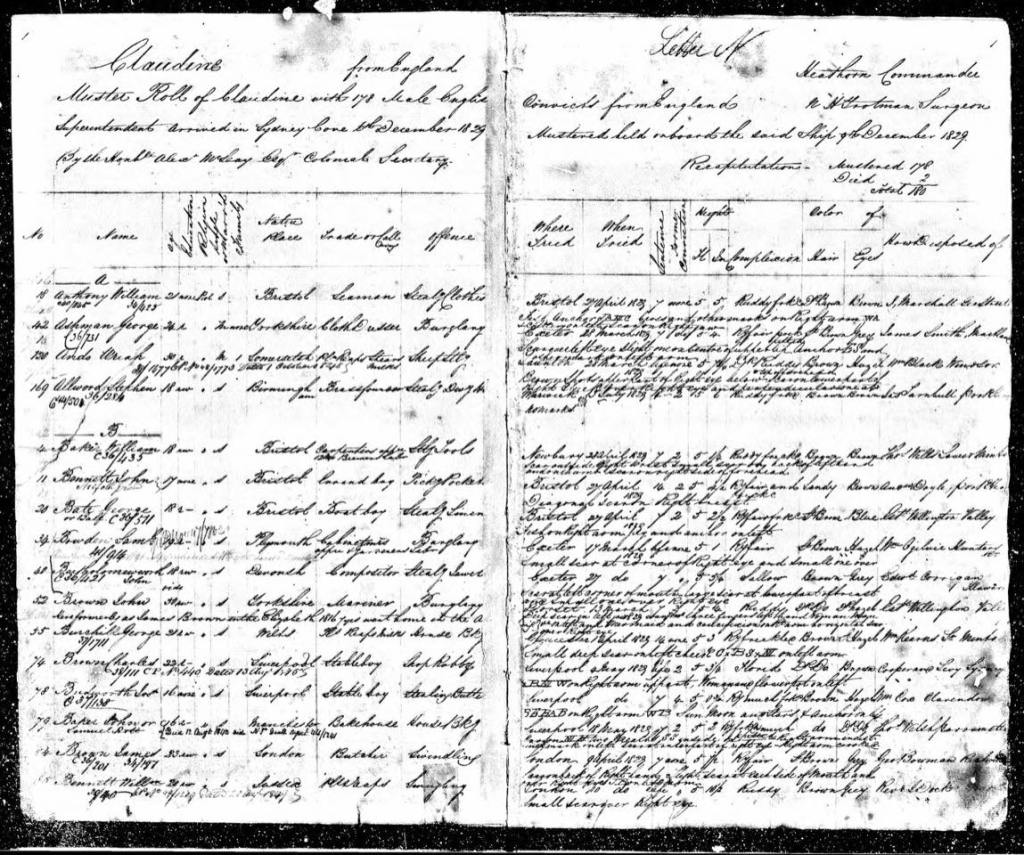
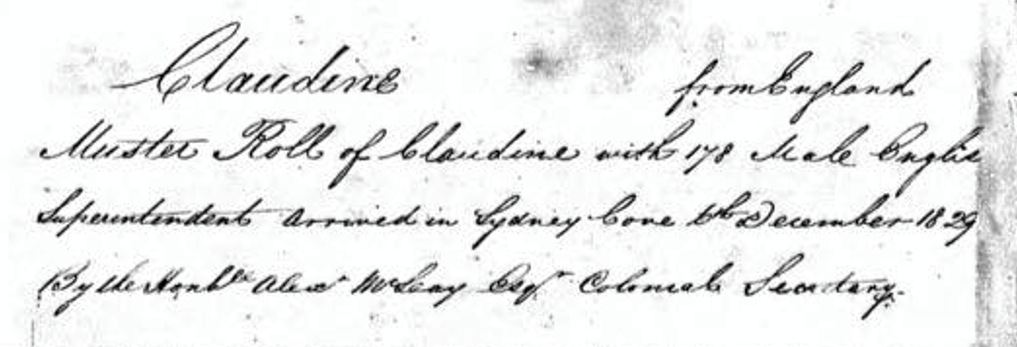






Budworth was assigned to work for William Cox of Clarendon, the same man who had worked with Colebee. Cox’s “large estate at Clarendon near Windsor had all the appearance of a self-contained village. Over fifty convict servants acted as smiths, tanners, harness makers, wool sorters, weavers, butchers, tailors and herdsmen. Cox had steadily improved his flocks, which Commissioner Bigge described in 1820 as among the six best in the colony.”
1820s-1840s – The Cox Family and the Liverpool Plains Area
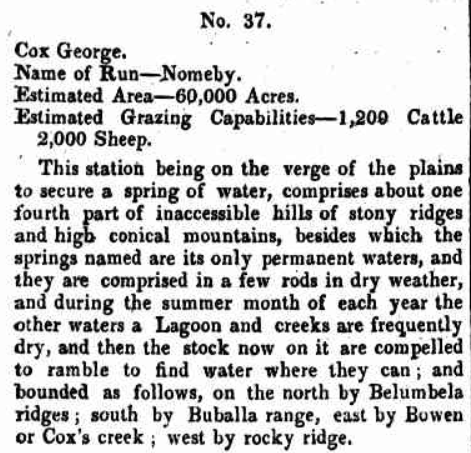
From 1826, three of Cox’s sons, George, Henry and Edward, progressively staked claims to the Liverpool Plains area including at Binnea, Noemby or Nombi, and Connabarabran.
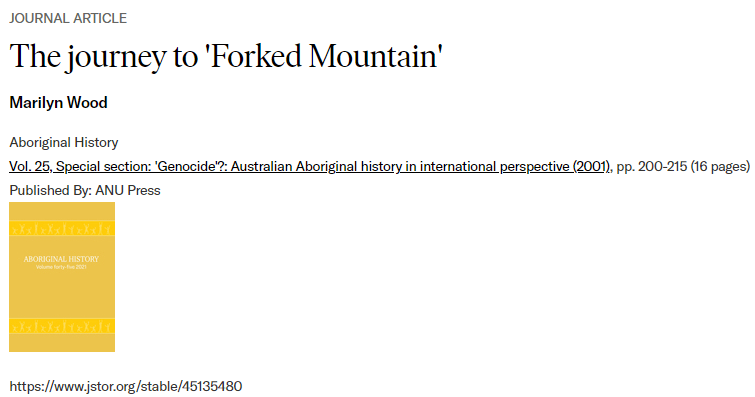
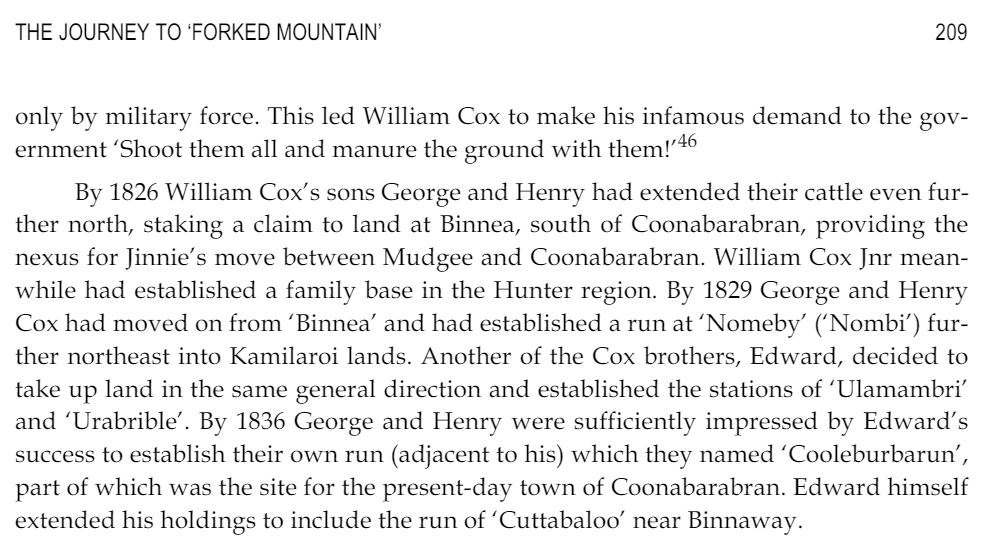

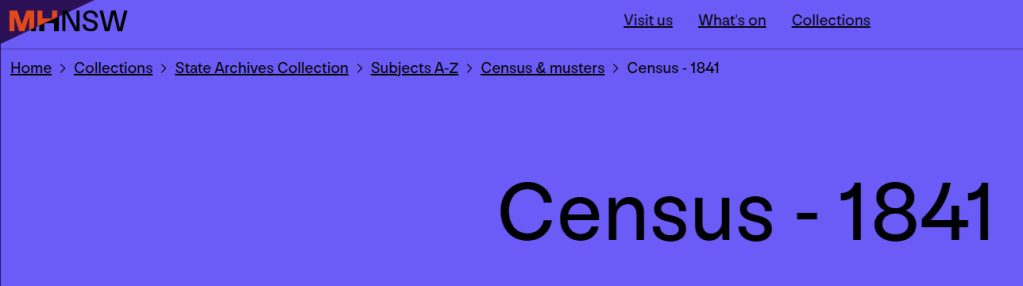
The 1841 NSW Census shows that “G and H Cox” were in residence on the “District Liverpool Plains”.
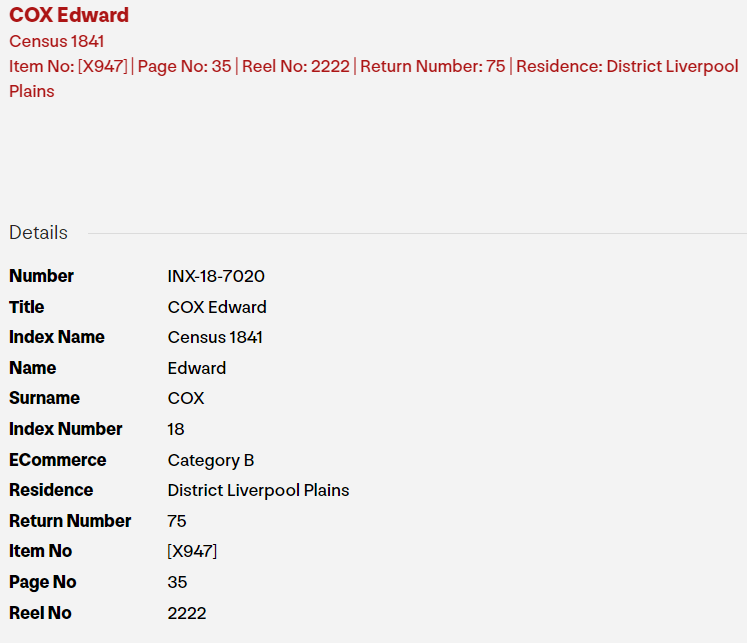
Similarly, another of William Cox’s sons “Edward Cox”, was in residence on the “District Liverpool Plains”.


c.1831 Death of Colebee
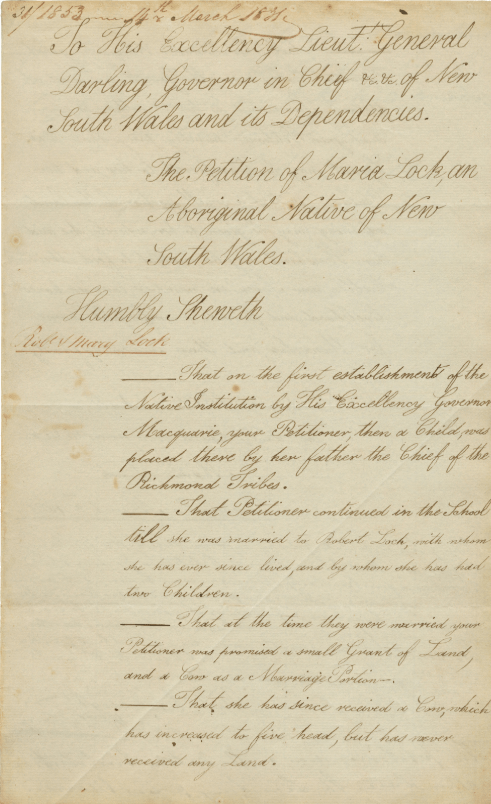
By 1831, Colebee had died. On 14 March 1831, Maria Lock wrote a letter requesting she be awarded her brother Colebee’s land, resulting in her being granted his 30 acres of land at Blacktown.
c.1831 – Kitty and Joseph Budworth Meet
1832 – Birth of Kitty and Joseph’s First Child Catherine
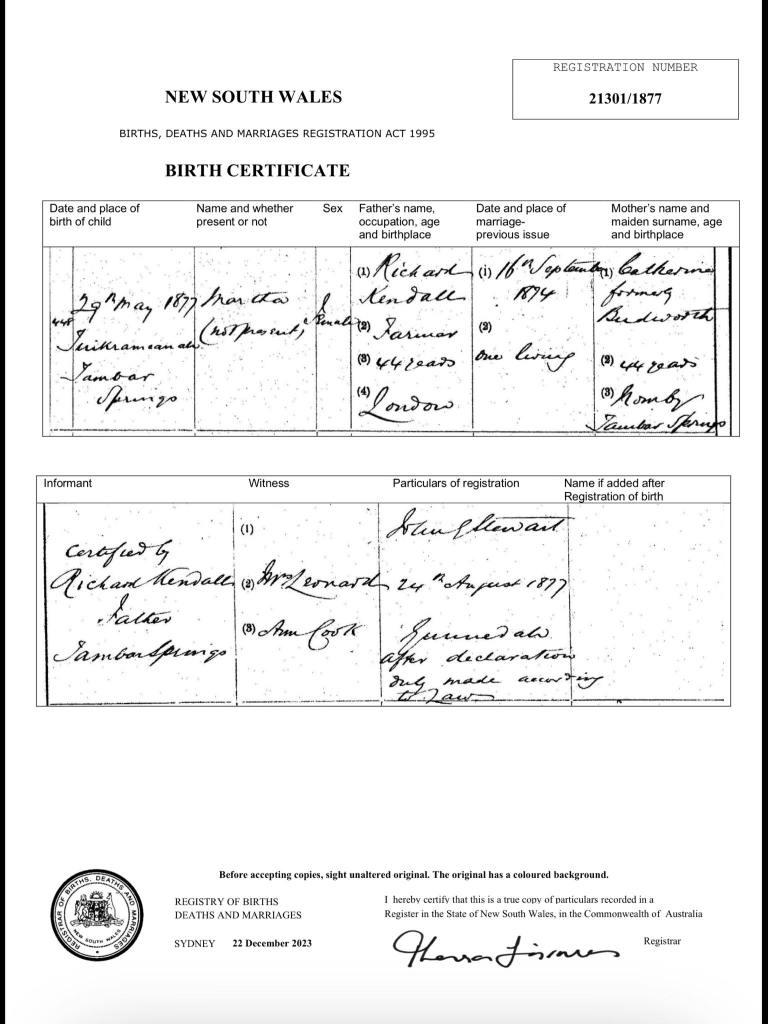
In 1832, Joseph and Kitty had a daughter named Catherine, who was born in Nomby. Catherine’s daughter Martha’s birth certificate states her mother’s name, maiden surname and birthplace was “Catherine”, “formerly Budworth” and “Nomby, Tambar Springs”.
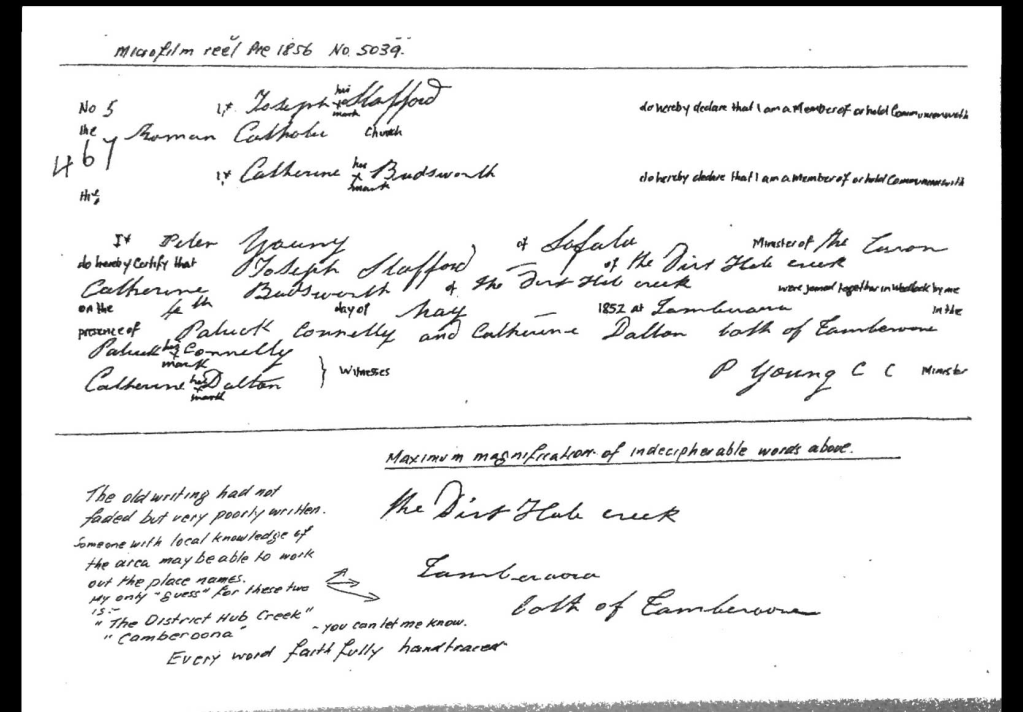
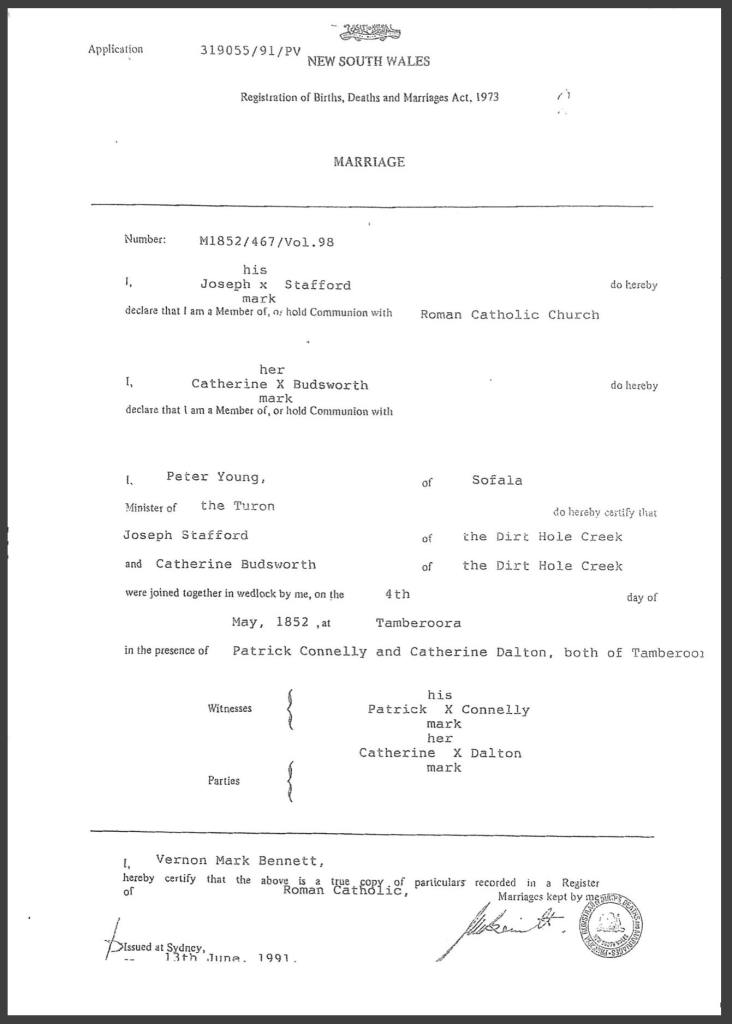
On 4 May 1852, Catherine married Joseph Stafford.
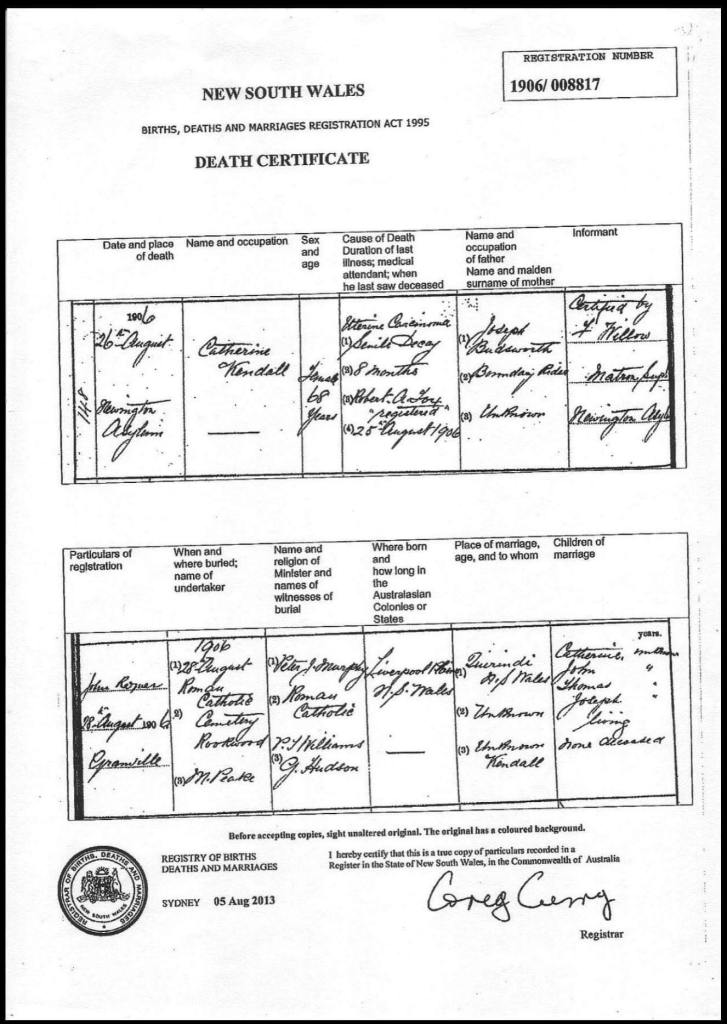
Catherine died 26 August 1906. Catherine’s death certificate states her father was Joseph Budsworth, and his occupation was ‘Boundary Rider’. It states the maiden surname of her mother was unknown.
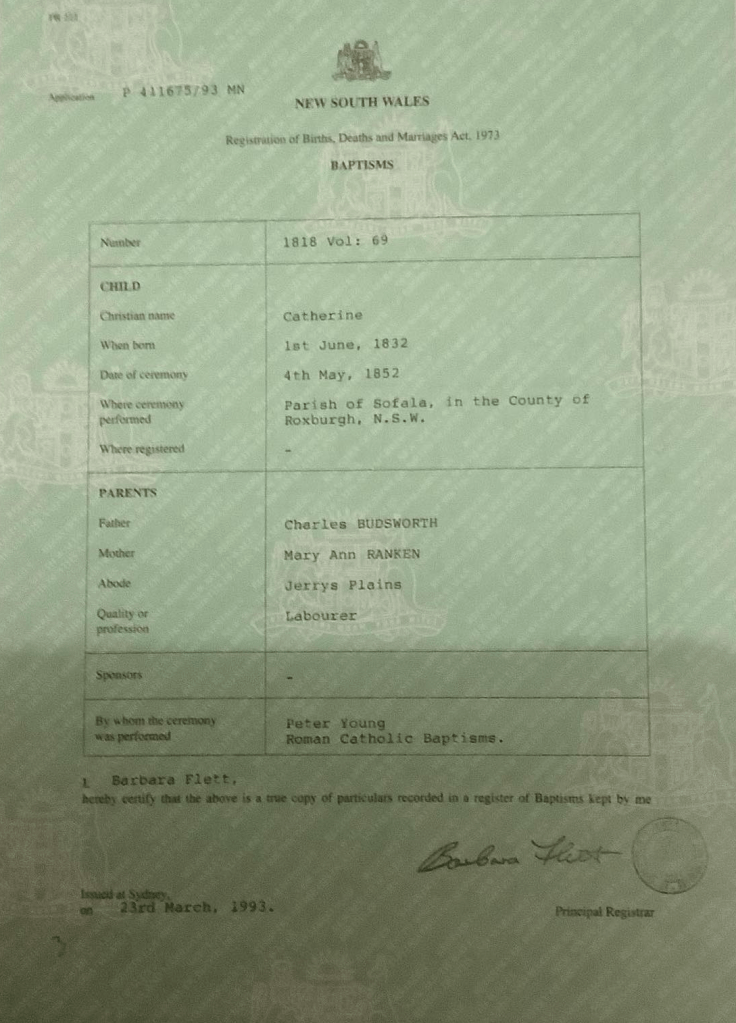
Interestingly, Catherine’s baptism certificate provides a number of incorrect details as to who her parents were. The reasons for this are detailed below under the heading ‘Risk of Aboriginal Child Removal’.
Risk of Aboriginal Child Removal
Indeed, Catherine’s own mother Kitty Warmuli had been placed in the Parramatta Native Institution in 1814, when she was 5 years old. Children were not allowed to leave the Native Institution. “Aboriginal parents had resisted the school and pined for their children from the beginning – an open slat fence was built early in 1815 to provide parents the requested opportunity to gaze upon their children while at school. Shelley, before his early death in 1815, noted the reluctance of Aboriginal parents to give up their children and Yarramundi spoke of the fear of ‘men in black clothes’ taking the children to the Institution in 1818.” (Brook and Kohen, 1991, p.263).
The pervasive threat of child removal would have been particularly fierce for a teenage Aboriginal girl in the mid-1800s, explaining why Catherine’s baptism certificate did not identify her mother as Aboriginal, and instead listed another ‘Budsworth’ family. However, for Catherine’s death certificate, there is no reason for there to have been false information, indicating this is highly likely to be accurate.
Joseph’s three sons each have their father’s name as Joseph Budworth or Budsworth, and their mother’s name was listed for the 1833 birth of Joseph as “Kitty Budsworth”, the 1840 birth of James as “Aboriginal”, and the 1843 birth of John as “Kitty Aborigini”. Furthermore, Joseph’s death certificate states his father was Joseph Budworth and his mother was “Black Kitty”.
Nombi Station or Nomby
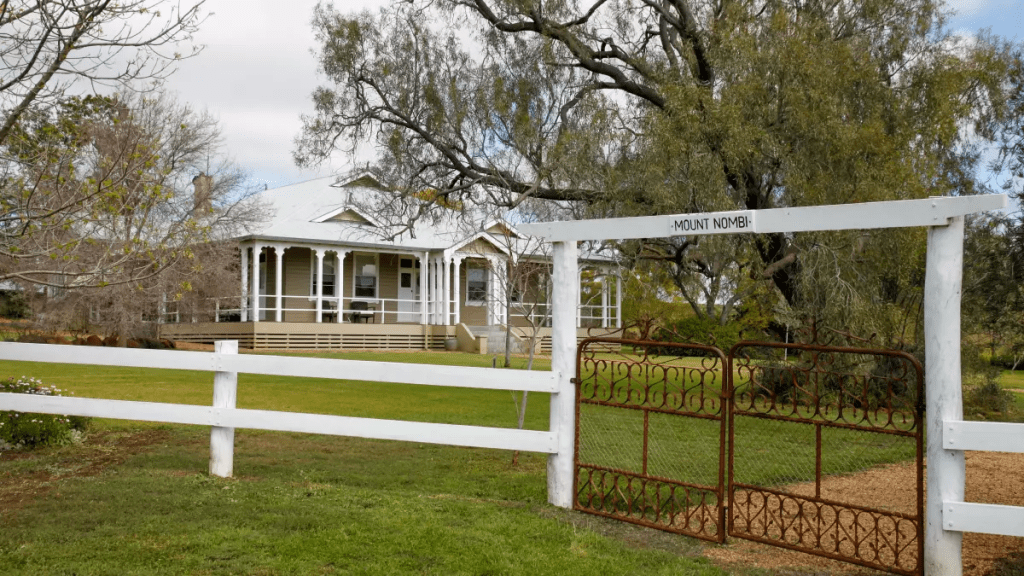
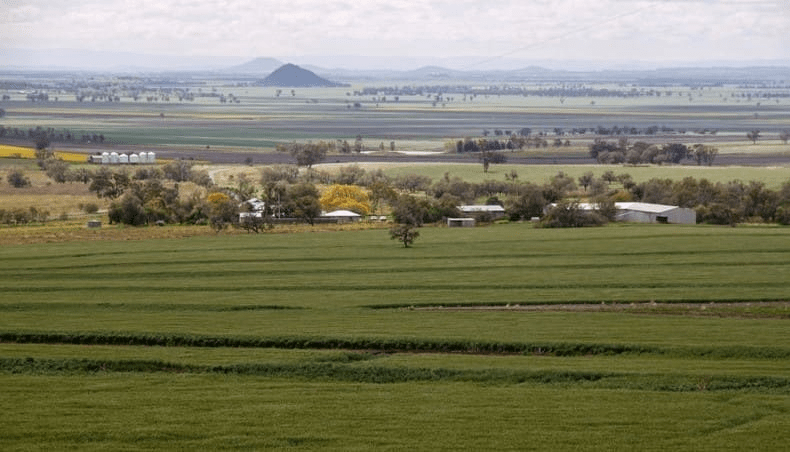
As per Catherne’s birth certificate, she was born at Nomby, Tambar Springs. Nomby is consistent with the land owned by George Cox and Henry Cox, as detailed earlier. A 1905 photograph of Nombi Station was published by the Art Gallery NSW in 1980.

‘The Land’ Newspaper published an article about Nombi Station on 6 September 2020: “Mount Nombi has a long history, being owned by the early pioneering families of the Liverpool Plains. First settled by the Cox family, from which the nearby Cox’s Creek is named. The property Nombi Station which included Mount Nombi, was purchased by the Orr family who came from Ireland to the Liverpool plains in the early 1860s.”
Budworth the Boundary Rider
This occupation is of particular note as Budworth had been a stable boy in England, and the Cox family were pastoralists.
The spelling of Budworth and Budsworth
The alternate spelling of Budworth’s children’s names in their baptism certificate demonstrate that Joseph was alternately referred to as both Budworth and Budsworth.
As the Australian Institute of Aboriginal and Torres Strait Islander Studies has stated, “Be mindful of spelling variations as people often recorded information as it sounded and in earlier times many people could not read and write.”
1833 – Birth of Joseph (Junior), alias Myall Joe
Joseph (Junior) was born on 27 June 1833.
Baptised 1 June 1842 in West Maitland by J. T. Lynch, Roman Catholic. This baptism certificate states the father was Joseph Budsworth and his mother was Kitty Budsworth.
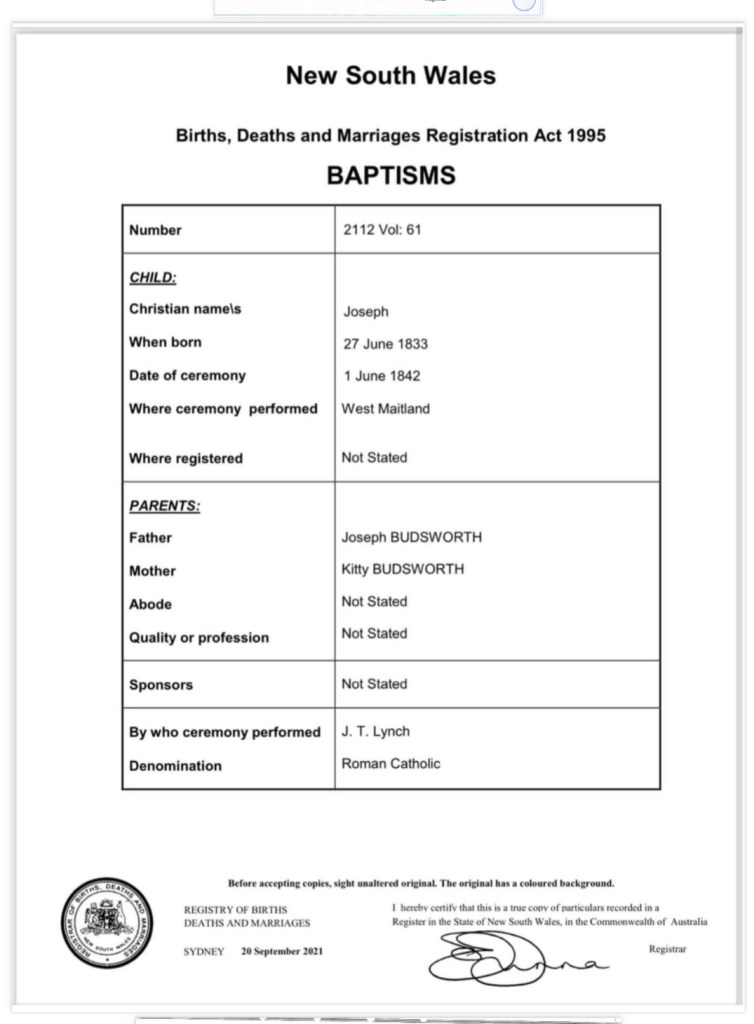
NOTE: Dean John T. Lynch, “who had arrived in Australia in 1838 and was stationed at Maitland in the same year, was closely associated with New England. Of him Monsignor P Hartigan wrote “He was a first-class horseman and as hard as the horse that bore him. He pioneered the Liverpool Plains, went further north than Armidale and combed the whole of the intervening country.” Joseph (Junior)’s baptism certificate shows that Lynch baptised him in June 1842, consistent with the Catholic Church’s records.
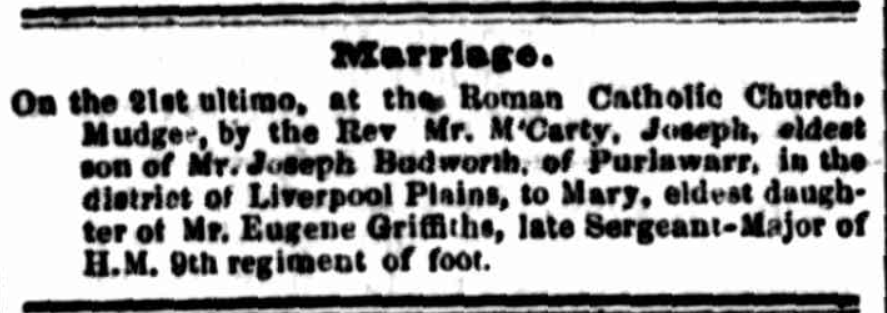
On 15 October 1860, it was reported in the New South Wales Police Gazette and Weekly Record of Crime “Coonabarabran: Escaped, on the 4th instant, from the stable which is at present used as a lock-up-Joseph Budworth, alias Young Myall Joe, and Charles Johnston. Myall Joe is a half-case, about 5 feet 2 inches high, black hair, 26 years of age, has a deep scar under the eye.

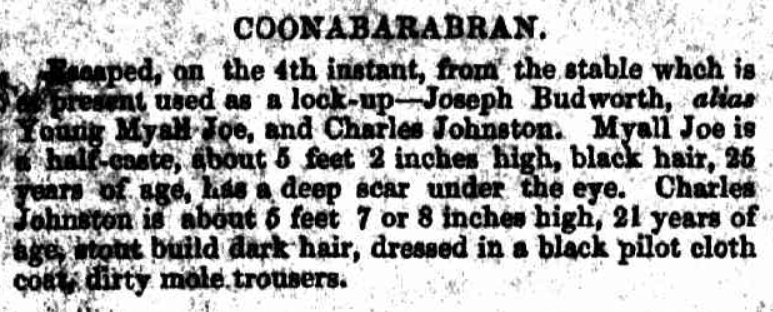
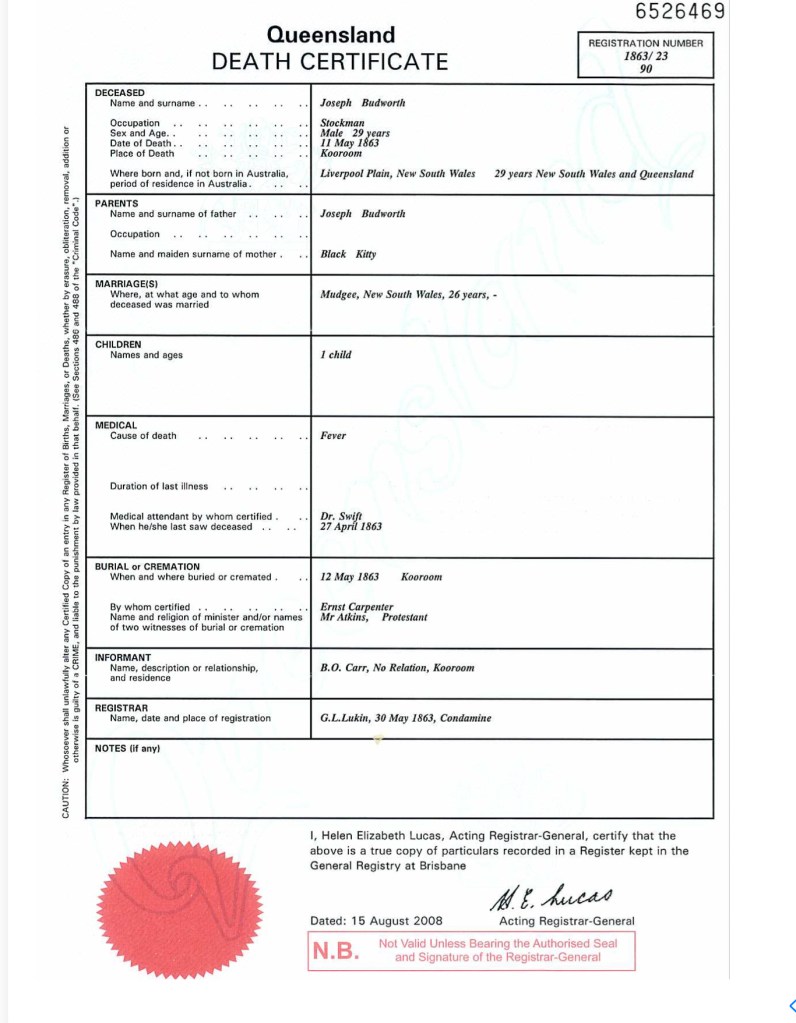
Died 11 May 1863 in Queensland. The death certificate states his father was Joseph BUDWORTH and his mother was Black Kitty.
The Meaning of ‘Myall’
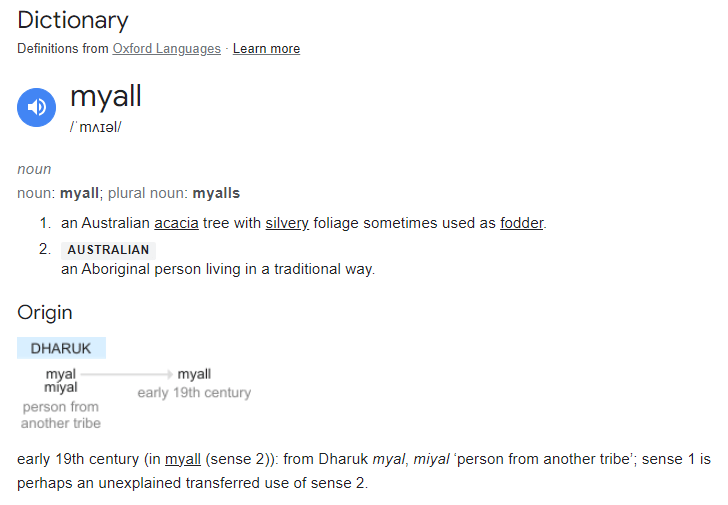
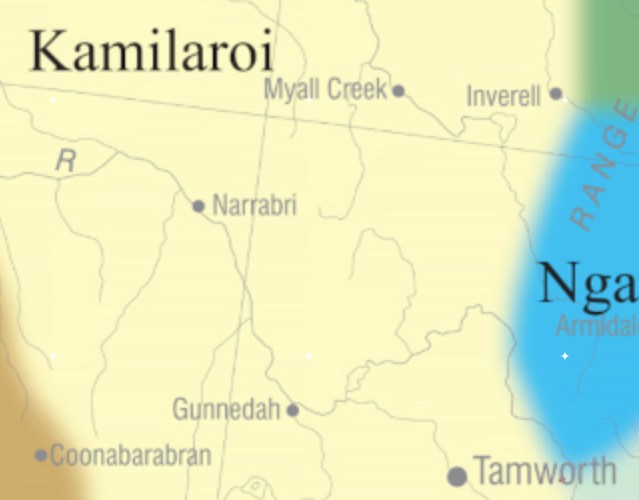
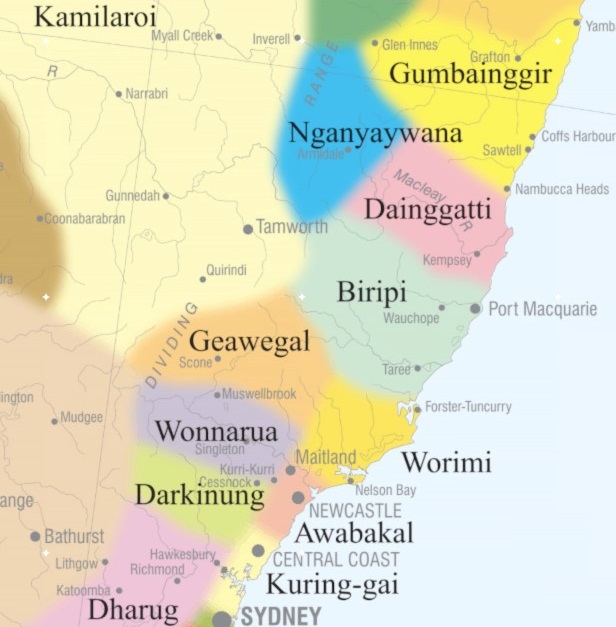
Kitty was Dharug, providing a fascinating connection of the word Myall, with Kitty and her family being from the Dharug tribe, living on Kamilaroi lands.
Baptism Certificate Points of Note
The alternate spelling of Budworth’s children’s names in their baptism certificate demonstrate that Joseph was alternately referred to as both Budworth and Budsworth. As the Australian Institute of Aboriginal and Torres Strait Islander Studies has stated, “Be mindful of spelling variations as people often recorded information as it sounded and in earlier times many people could not read and write.”
The fact that the baptism certificate of Joseph Budworth (Junior) states that his father was Joseph Budsworth and his mother was Kitty Budsworth is a strong indication that Joseph and Kitty were married, as she had taken his last name. However, no marriage certificate has been found to date.
1837 – Joseph Budworth Receives His Certificate of Freedom
On 15 February 1837, Budworth received his ‘Certificate of Freedom’.
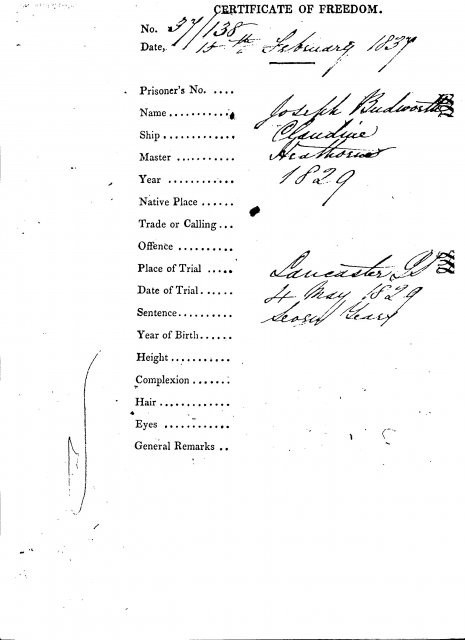

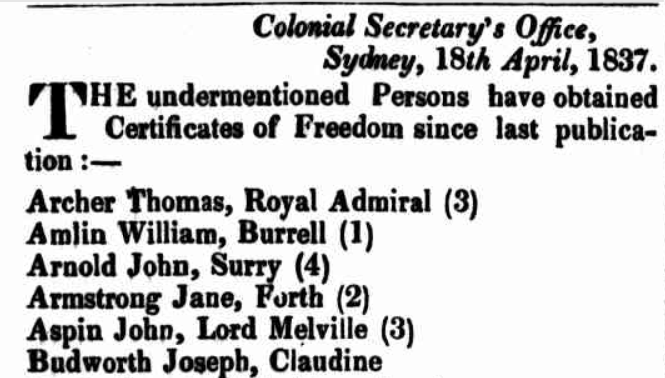
“In the early decades of the New South Wales penal colony, convicts usually arrived with a sentence of seven years, fourteen years, or life… British government and legal officials in either London or Dublin, produced lists known as indentures or indents, giving details of the name, date and place of conviction and sentence of each convict sailing on a ship…”
“The captains of convict transports handed these documents to the Governor of New South Wales and his Secretary (later known as the Colonial Secretary at the Colonial Secretary’s Office, Sydney). When a convict’s sentence had expired, he or she could apply for a certificate of freedom… this was an official document issued by the Colonial Secretary and signed by the Governor confirming that a convict was a free person with an expired sentence who was restored to rights of citizenship, in particular the right to unrestricted paid employment…”
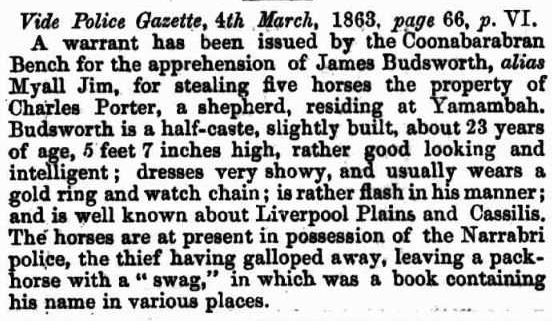
1840 – Birth of James, alias Myall Jim
James. Born 1840. Baptised 12 August 1845 by J. T. Lynch, Roman Catholic. This baptism certificate states the father was Joseph BUDWORTH and the mother was Aboriginal.


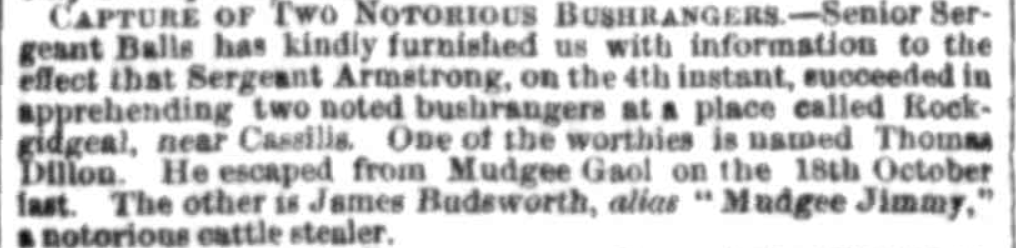
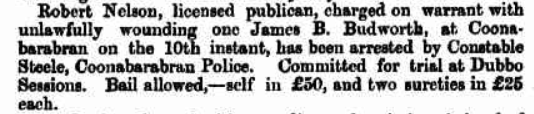
The 9 April 1863 Mercury and Hunter River General Advertiser Newspaper stated in an article “CAPTURE OF TWO NOTORIOUS BUSHRANGERS”, “Senior Sergeant Balls has kindly furnished us with Information to the effect that Sergeant Armstrong, on the 4th Instant, succeeded in apprehending two noted bushrangers at a place called Rockgidgeal, near Cassills. One of the worthies Is named Thomas Dilllon. He escaped from Mudgee Gaol on the 18th October last. The other is James Budsworth, alias “Mudgee Jimmy”, a notorious cattle stealer.

The 16 April 1863 Maitland Mercury and Hunter River General Advertiser Newspaper stated “James Budsworth, alias ” Mudgee Jimmy,” still lies in Cassilis lockup. This prisoner has to be forwarded to Coonabarabran bench, to be dealt with on a charge of horse stealing”.


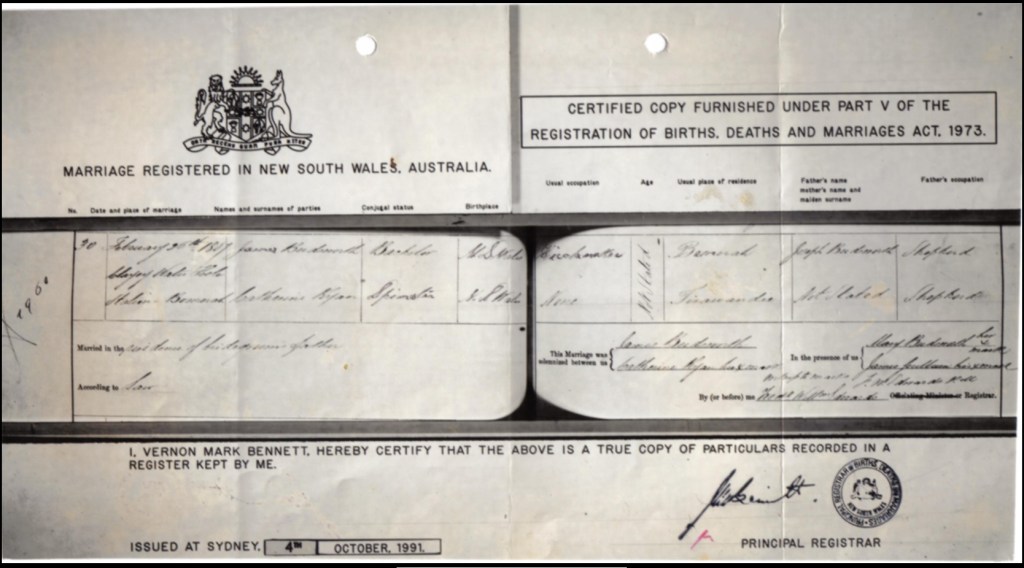
In 1867 married Catherine RYAN in Coonabarabran, NSW.

1843 – Birth of John
John was born in October 1843.

Baptised 22 October 1845 by J. T. Lynch, Roman Catholic. This baptism certificate states the father was Joseph Budsworth and the mother was Kitty Aborigini (sic). The parents abode was “American River”. The baptism ceremony was performed in the “Parish of West Maitland in the County of Northumberland NSW”.
1849 – Birth of Mary
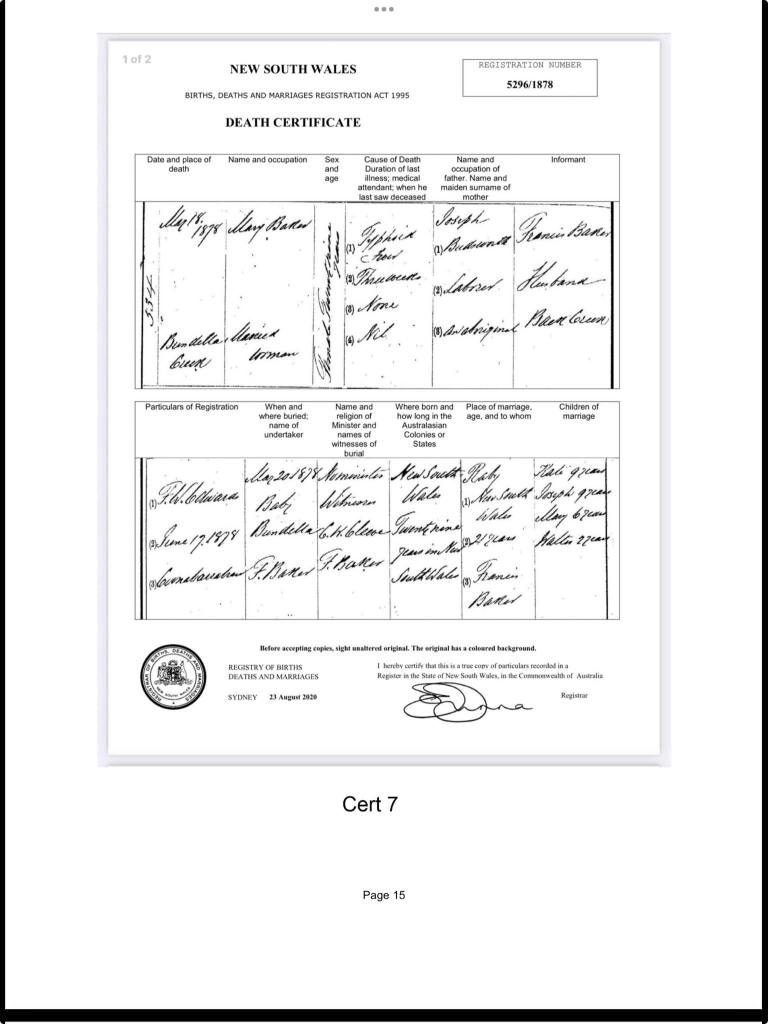
Died 18 May 1878. Mary’s death certificate states her father was Joseph Budsworth, and his occupation was ‘Laborer’. It states the maiden surname of her mother was “An Aboriginal”.
c.1852 – Birth of Sarah
Sarah was born in c.1852.
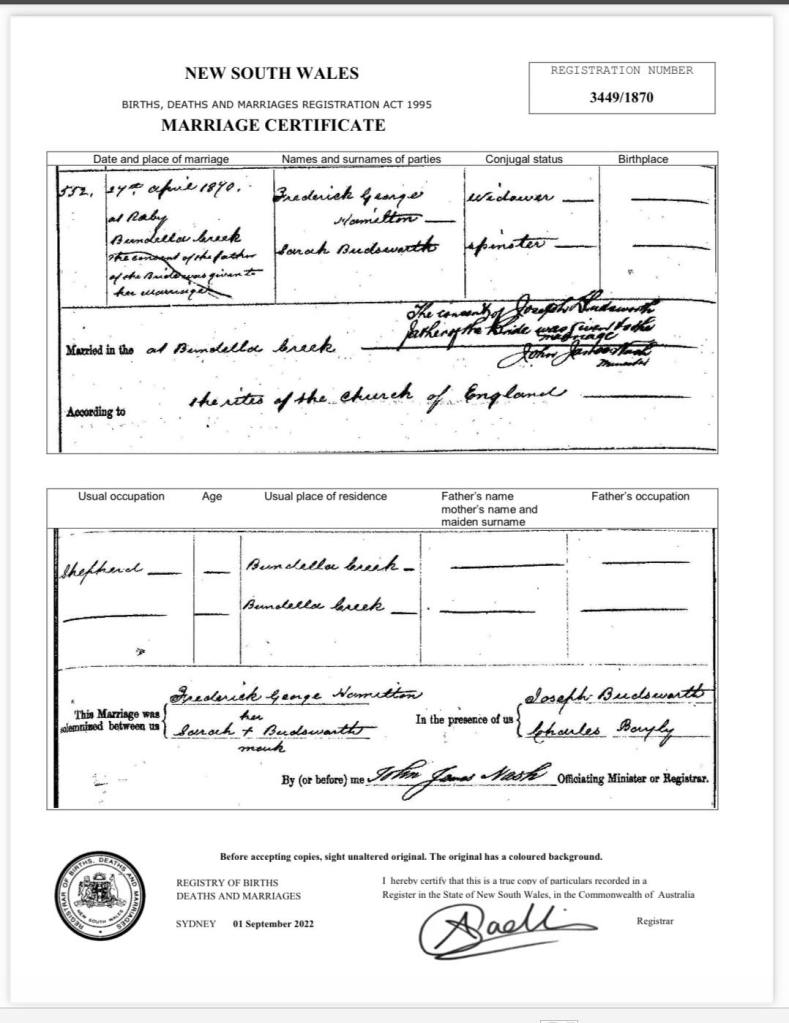
On 24 April 1870, Sarah married Frederick George Hamilton. Their usual place of residence is both recorded as ‘Bundella Creek’.
Died 19 October 1886 in Inverell, NSW. Sarah’s death certificate states her father was Joseph.
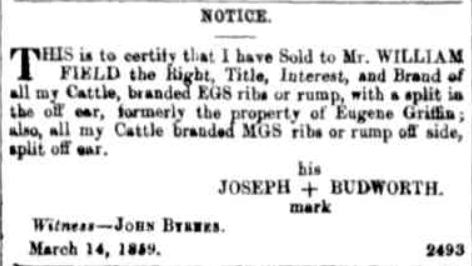
1859 – Budworth Sells Cattle

1865 – A Woman Named Kitty Committed to Jail
On 28 July 1865, as per the record of the Maitland Mercury and Hunter River General Advertiser newspaper, an Aboriginal woman named Kitty was committed to jail by the Tamworth Court. This was in the same region where Kitty had her children. This is not confirmed to be the same Kitty as our grandmother, though the timing and region is consistent.
1866 – Kitty Sentenced to Jail
On 6 July 1866, the record “Return of Prisoners Tried at the Different Courts of Quarter Sessions, 1866, Tamworth Quarter Session, 6 July 1855” stated the following: Name: Kitty (Aboriginal) Offence: Stealing a watch. When and Where Tried: Tamworth Quarter Sessions. Sentence: Twelve months imprisonment, Maitland Gaol.


On 21 July 1866, The Armidale Express and New England General Advertiser stated “Kitty, aboriginal, stealing a watch, one year”.




1866 – Kitty Dies
On 28 June 1866, Kitty died in custody from consumption, which is another name for tuberculosis. The Maitland Mercury stated: “An inquest was held at the East Maitland gaol, yesterday, by the coroner, James Thomson Esq, on the body of an Aboriginal woman named “Kitty,” who arrived in gaol on a committal by the Tamworth bench, on July 28th last year. It appears by the evidence of Dr. Wilton, the deceased showed symptoms of disease of the lungs soon after her admission into gaol, and has been in the habit of spitting large quantities of blood. Everything was done to her that could tend to her comfort and relief, nevertheless she died about nine o’clock on Thursday evening. Verdict Death from consumption.”

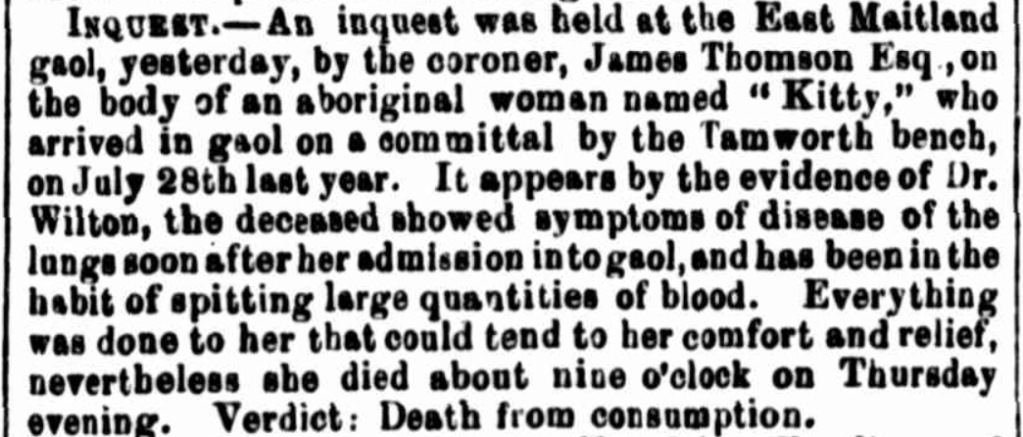
Of note, Kitty did NOT die from alcohol consumption, which had previously been incorrectly false alleged online. This is a false and improper conclusion as per Dr Wilton’s explicit findings.
Kitty’s Legacy
Kitty is recognised by the City of Parramatta as a “Significant Aboriginal woman”.
Kitty’s descendants number in the hundreds today, including numerous great-great-great-great-great grandchildren. This website will further explore stories of Kitty’s descendants.
1872 – Budworth Lapsed Conditional Purchase of Land
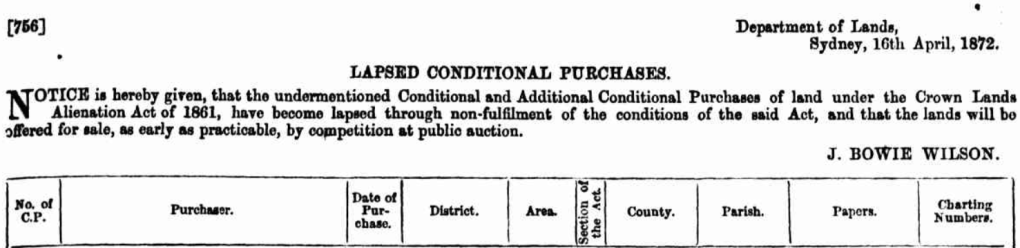
In the 16 April 1872 New South Wales Government Gazette, it stated that the Conditional Purchase of Crown Lands purchased by Joseph Budworth had become lapsed.

1872 – Budworth Recorded in a NSW Census
On 1 August 1872, Budworth was recorded as living in the Gunnedah District, Pottinger County, Bundalla Parish at Coolah.


1880s – Budworth “An Old Man” Living on the Liverpool Plains
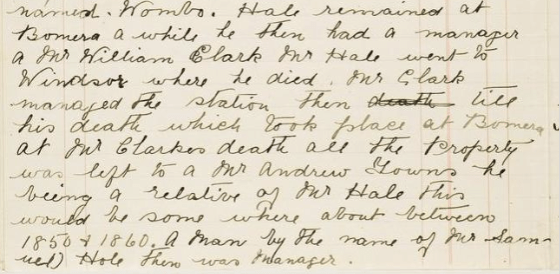
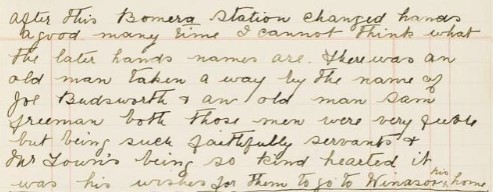
As an “old man”, Budworth was still living on the Liverpool Plains. The diary of Mary Jane CAIN has been published by the State Library of New South Wales and is quoted below.


Hale remained at Bomera a while he then had a manager a Mr William Clark Mr Hale went to Windsor where he died. Mr Clark managed the station then till his death which took place at Bomera. At Mr Clarkes death all the property was left to a Mr Andrews Towns he being a relative of Mr Hale this would be some where about between 1850 & 1860. A man by the name of Mr Samuel) Hole was manager.
1892 Death and Burial of Joseph
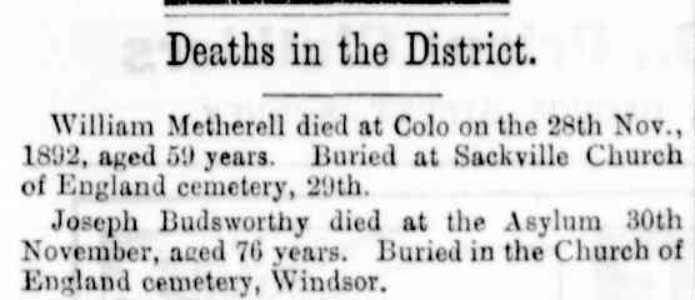
On 30 November 1892, Budworth died at Hawkesbury Benevolent Asylum, Windsor. NSW Death Registration Number 1892/14064.
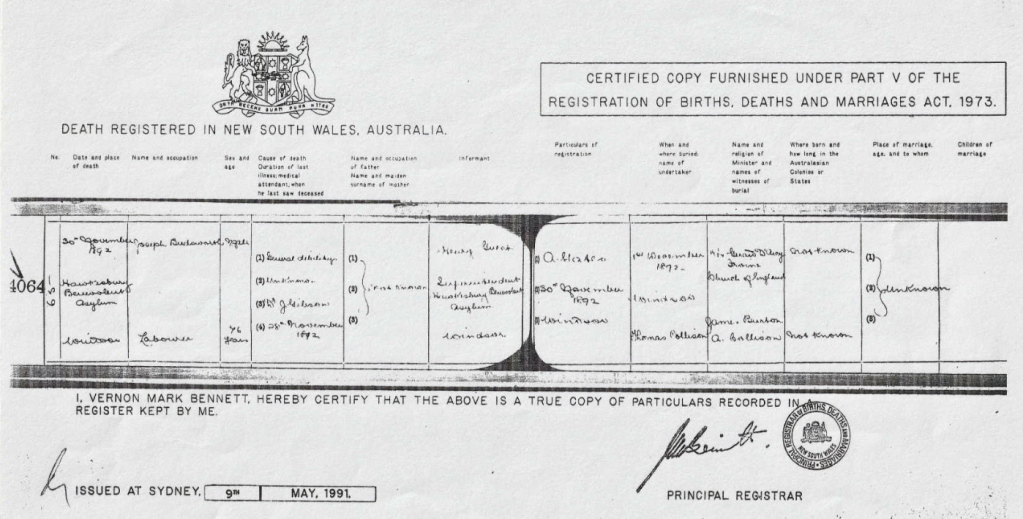
NOTE: The Hawkesbury Benevolent Asylum was founded in 1818 by Archibald Bell and William Cox, who Budworth had first been assigned to upon arriving in Australia as a convict, 63 years earlier.

Text References
- Brook, J. Kohen, J L. The Parramatta Native Institution and the Black Town : A History (1991). Kensington, NSW: New South Wales University Press, pages 59-62. ↩︎
- Sharpe, A. (2000). Pictorial history Blacktown and District. Alexandria, Australia: Kingsclear Books. ↩︎
- Brook, J. and Kohen, J. (1991). The Parramatta Native Institution and the Black Town: A History. Kensington NSW: New South Wales University Press. ↩︎
- The National Archives; Kew, London, England; PCOM 2: Metropolitan Police: Criminal Record Office: Habitual Criminals Registers and Miscellaneous Papers
Description
Year Range: 1874
Source Information
Ancestry.com. UK, Prison Commission Records, 1770-1951 [database on-line]. Lehi, UT, USA: Ancestry.com Operations, Inc., 2020.
Original data:PCOM 2 1770-1951 Home Office and Prison Commission: Prisons Records, Series 1. Kew, Surrey, England: The National Archives. ↩︎ - Class: HO 27; Piece: 27; Page: 389
Description
Year: 1824
Source Information
Ancestry.com. England & Wales, Criminal Registers, 1791-1892 [database on-line]. Lehi, UT, USA: Ancestry.com Operations Inc, 2009. This collection was indexed by Ancestry World Archives Project contributors.
Original data:Home Office: Criminal Registers, Middlesex and Home Office: Criminal Registers, England and Wales; Records created or inherited by the Home Office, Ministry of Home Security, and related bodies, Series HO 26 and HO 27; The National Archives of the UK (TNA), Kew, Surrey, England. ↩︎ - The National Archives; Kew, London, England; PCOM 2: Metropolitan Police: Criminal Record Office: Habitual Criminals Registers and Miscellaneous Papers
Description
Year Range: 1874
Source Information
Ancestry.com. UK, Prison Commission Records, 1770-1951 [database on-line]. Lehi, UT, USA: Ancestry.com Operations, Inc., 2020.
Original data:PCOM 2 1770-1951 Home Office and Prison Commission: Prisons Records, Series 1. Kew, Surrey, England: The National Archives. ↩︎ - Brook, J. and Kohen, J. (1991). The Parramatta Native Institution and the Black Town: A History. Kensington NSW: New South Wales University Press. ↩︎
- The National Archives; Kew, London, England; PCOM 2: Metropolitan Police: Criminal Record Office: Habitual Criminals Registers and Miscellaneous Papers
Description
Year Range: 1874
Source Information
Ancestry.com. UK, Prison Commission Records, 1770-1951 [database on-line]. Lehi, UT, USA: Ancestry.com Operations, Inc., 2020.
Original data:PCOM 2 1770-1951 Home Office and Prison Commission: Prisons Records, Series 1. Kew, Surrey, England: The National Archives. ↩︎ - Class: HO 27; Piece: 37; Page: 412
Description
Year: 1829
Source Information
Ancestry.com. England & Wales, Criminal Registers, 1791-1892 [database on-line]. Lehi, UT, USA: Ancestry.com Operations Inc, 2009. This collection was indexed by Ancestry World Archives Project contributors.
Original data:Home Office: Criminal Registers, Middlesex and Home Office: Criminal Registers, England and Wales; Records created or inherited by the Home Office, Ministry of Home Security, and related bodies, Series HO 26 and HO 27; The National Archives of the UK (TNA), Kew, Surrey, England. ↩︎
Joseph Budworth’s Unknown Parents and Mistaken Identity
A number of family trees, websites and documents have incorrectly stated that Joseph Budworth the convict born 1813, was actually a man by the name of Joseph Bore born 1811, the son of John Budsworth Bore and Margaret Bore nee Woods.
In March 2024, this case of mistaken identity was comprehensively refuted by evidence and by the unanimous agreement of independent experts in a WikiTree Genealogist-to-Genealogist forum.
Comparative Synopsis of the Lives of Joseph Budworth and Joseph Bore
Joseph Budworth was born in 1813 to unknown parents, though he has the alias of ‘Davis’ in some records. In 1829 as a convict he was transported to Sydney, Australia. He had a family with an Aboriginal woman named Kitty: 1831 a daughter Sophie, 1832 a daughter Catherine, 1833 a son Joseph, 1840 a son James, 1843 a son John, and 1849 a daughter Mary. Joseph BUDWORTH lived the remainder of his life in New South Wales, dying in 1892.
In contrast, Joseph Bore lived his entire life in England. He was born on 1 August 1811 in Lancashire, England, baptised on 1 September 1811, married Jane Hargreaves in Lancashire, England in 1841, had 8 children with her (1841, 184, 1846, 1848, 1849, 1852, 1855 and 1860), and died in Lancashire, England, in 1862. There is no evidence Bore ever left England. There is no evidence Bore ever came to Australia.
Bore is a completely different person from an unrelated family. Joseph Budworth’s parents were not John Bore and Margaret Bore nee Woods.
Summary of Differences between Joseph Budworth and Joseph Bore
1) Joseph Budworth and Joseph Bore have different names. Joseph Bore’s last name was Bore, and Bore alone. This is evidenced on his birth certificate, the 1841 census, the 1861 census, the birth certificates of his siblings, and Bore’s death documentation, which lists his last name as Bore, and Bore alone.
2) Joseph Budworth was born in 1813 as per multiple records. Joseph BORE’s birth certificate states he was born in 1811.
3) Joseph Budworth was having a family in Australia with an Aboriginal woman named Kitty in the 1840s at the exact same time Joseph Bore was having a family in England with Jane Hargreaves, on the opposite sides of the world.
4) There is no evidence Joseph Bore ever left England.
5) There is no evidence Joseph Bore ever came to Australia.
6) There is no evidence Joseph Budworth ever left Australia after he arrived in 1829. Many details about his life in Australia and connection to the Liverpool Plains of New South Wales are well documented as per the above biography.
7) Joseph Bore died in England in 1862. Joseph Budworth died in Australia in 1892.
Independent Expert Analysis and Unanimous Refutation
1) Matthew Fletcher G2G6 Pilot: “Several experts on British genealogy have generously given their time to look at this case. The unanimous conclusion is that Joseph Budworth Bore and the transported Joseph Bud(s)worth were not the same person”.
2) Helen Ford G2G6 Pilot: “I agree with Matthew that there is no evidence to link the convict Joseph Budworth with the West Derby Budworth Bore” and “The biggest problem is that there is no evidence to connect Joseph Budworth Bore of West Derby with Joseph Budworth the convict.”
3) John Atkinson G2G6 Pilot: “The man who was baptised in 1811 (often transcribed under the name Joseph Budworth) is Joseph Bore, and is therefore separate from the Joseph Budworth who came before the Liverpool Court a number of times and was eventually transported to Australia for 7 years.”
4) Anonymous Baker G2G6 Mach 3: “For the baptism of Joseph Budworth Bore, he was recorded as ‘Joseph’ ; parents christian names = ‘John Budworth’ and ‘Margaret’ ; parents surname = ‘Bore’.”
5) Gillian Thomas G2G6 Pilot: “There is probably an argument for correcting the LNAB (Last Name At Birth) for https://www.wikitree.com/wiki/Budworth-55 to Bore, consistent with the name at baptism.”
6) Heather Jenkinson G2G6 Pilot: “I came to the same conclusion as most people Joseph Budworth and Joseph Budworth Bore are two different people.”
Request of Family Members
We request that in relation to Joseph Budworth, family members:
- Make sure Joseph Budworth’s Date of Birth is 1813, and not 1 August 1811.
- Delete the last name ‘Bore’ as his last name or associated with him.
- Remove all family relationships to anyone with the name of BORE. His father was not John Bore. His mother was not Margaret Bore nee Woods. Joseph Budworth’s parents are unknown.
Text and images on this website are generally copyright unless linked back to their original source.
 Kitty of the Warmuli Clan of the Dharug people & Joseph Budworth